The Check Hybrid System warning means the hybrid control computer has found a fault in the high-voltage battery, inverter, motors, their cooling or the 12-volt power that starts them. Pull over safely and restart once. A 12 V battery below about 12.2 V at rest or a near-empty tank are common, cheap causes.
- A 12-volt battery resting below about 12.2 V can stop a hybrid reaching READY and trigger hybrid faults.
- Running the tank very low can set Toyota codes P3190 or P3191 and the Check Hybrid System message.
- Toyota and Lexus hybrid batteries from model year 2020 are warranted for 10 years or 150,000 miles.
- Orange cables carry high voltage: checking fuel, the 12 V battery and the cooling vent is the safe limit for owners.
- What Does the Check Hybrid System Warning Mean?
- When Did the Warning Appear, and What Does That Point To?
- What Causes the Check Hybrid System Warning?
- What Role Does the 12-Volt Battery Play in a Hybrid?
- How Do You Narrow It Down?
- How Much Does It Cost to Fix?
- Can You Keep Driving With Check Hybrid System On?
- When Should You See a Mechanic?
- Frequently Asked Questions
- Related Guides
What Does the Check Hybrid System Warning Mean?
The Check Hybrid System warning means the hybrid control computer has found a fault in the parts that move the car electrically: the high-voltage battery, the inverter, the electric motors or their cooling, or the power that wakes them up. It is a general alarm, not a diagnosis, and the stored code says which part it is.
Toyota and Lexus pair it with the red master warning triangle; Hyundai and Kia use versions with different urgency.
| Message you see | Typical meaning |
|---|---|
| “Check Hybrid System” + master warning (Toyota, Lexus) | Hybrid fault stored; the car may enter a reduced-power fail-safe mode |
| “Check Hybrid System. Stop the vehicle in a safe place” (Toyota, Lexus) | Serious fault; the hybrid system may shut down soon |
| “Check Hybrid system. Stop safely.” (Hyundai, Kia) | Hybrid system problem; the READY light blinks and a chime sounds |
| “Check Hybrid system. Do not start engine” (Hyundai, Kia) | Hybrid battery charge (SOC) is too low |
Wording varies by model year; your owner’s manual is the final word.
When Did the Warning Appear, and What Does That Point To?
When the Check Hybrid System warning first appeared is the quickest clue to its cause. A cold morning points to the small 12-volt battery, a near-empty fuel tank to an engine that would not run, and a slow fall in fuel economy to an ageing hybrid battery.
| When it happens | Most likely cause | Check first |
|---|---|---|
| At start-up after the car sat for days; READY slow to appear | Weak 12-volt auxiliary battery | 12 V voltage at rest |
| Fuel gauge near empty, engine sputtered or would not run | Engine starved of fuel (Toyota P3190/P3191) | Add several gallons, then rescan |
| Hot weather or long climbs; fan noise from behind the rear seat | Clogged hybrid battery cooling intake or fan | Intake vent and filter |
| Engine runs almost constantly, mpg falling for months | Hybrid battery wear (P0A80, P0A7F) | Hybrid code scan and block voltages |
| Sudden loss of power at speed, several lights at once | Inverter or inverter cooling fault (P0A78, P0A93) | Dealer-level hybrid scan, recall check |
What Causes the Check Hybrid System Warning?
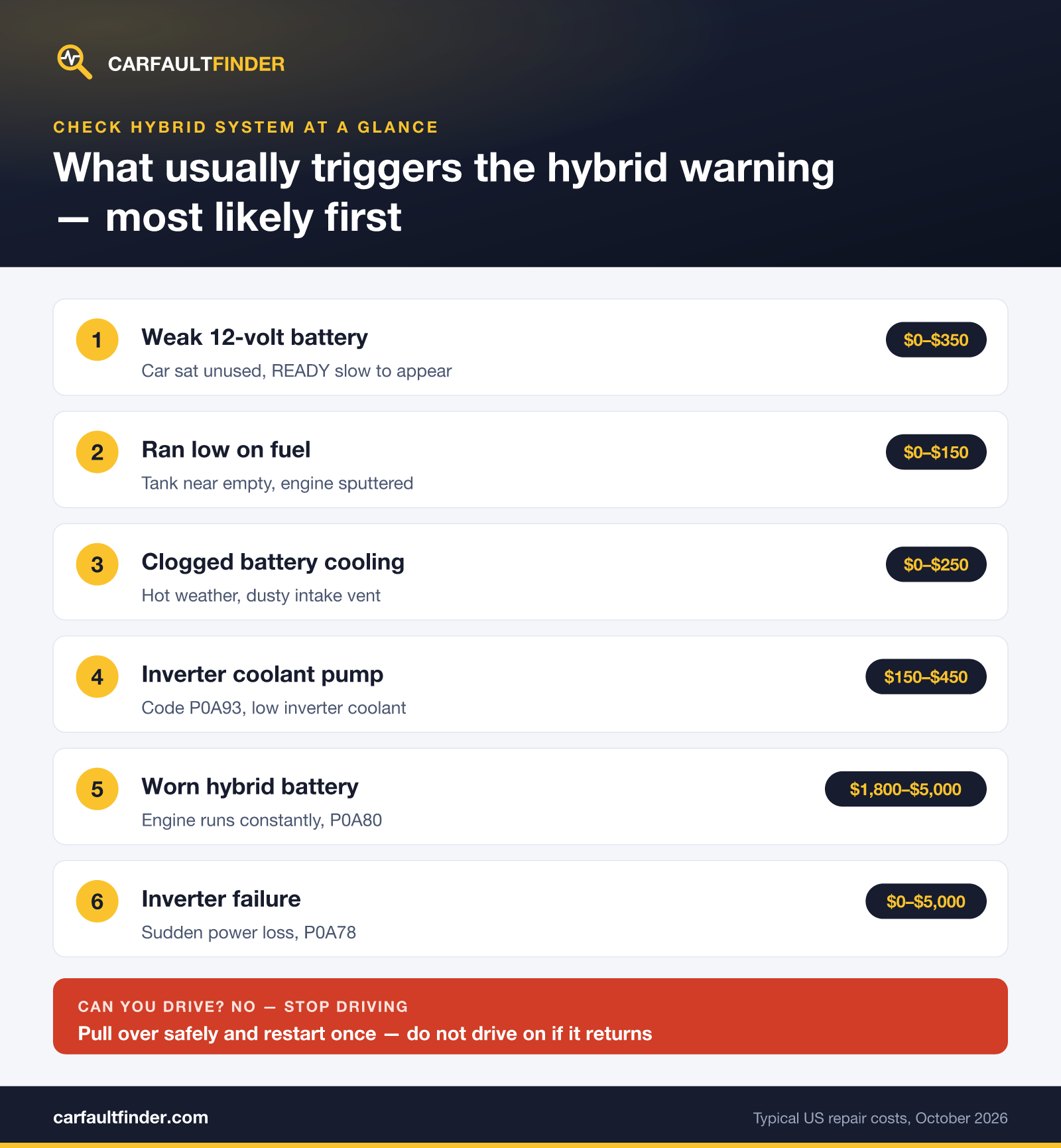
The Check Hybrid System warning has a handful of common causes, and the cheap ones lead. A tired 12-volt battery or running the tank too low explains many messages that never needed a new hybrid battery, so rule those out before accepting a quote for an expensive repair.
A weak 12-volt auxiliary battery. Recognise it by: a car that sat unused, dim lights at switch-on and READY that is slow to appear or does not appear. Usual fix: charge or replace the 12 V battery, $0–$350.
Running low on fuel. A hybrid still needs its petrol (gasoline) engine. If it cannot run, Toyota software sets codes such as P3190 (poor engine power) or P3191 (engine does not start). Recognise it by: a near-empty tank and a sputter before the warning. Usual fix: refuel and have the codes cleared, $0–$150.
Clogged hybrid battery cooling. Many hybrids cool the high-voltage battery with cabin air drawn through a vent near the rear seat; pet hair and dust block it. Recognise it by: warnings in hot weather or a “Maintenance required for traction battery cooling parts” message. Usual fix: vacuum the intake vent cover; filter and fan cleaning at a garage, $0–$250.
Low inverter coolant or a failed inverter coolant pump. The inverter has its own cooling loop with an electric pump. Recognise it by: code P0A93 (Inverter “A” Cooling System Performance) and a low level in the separate inverter reservoir. Usual fix: repair the leak or replace the pump, $150–$450.
An ageing hybrid battery. Recognise it by: the engine running far more often, falling mpg and codes P0A80 (Replace Hybrid Battery Pack) or P0A7F (Hybrid Battery Pack Deterioration). Usual fix: replace the pack, $1,800–$5,000.
Inverter, motor or control module failure. Power electronics can fail; the 2010-2015 Prius inverter is the best-known case, covered in our Toyota Prius common problems guide. Recognise it by: sudden power loss and codes such as P0A78. Usual fix: recall or coverage work, otherwise $2,500–$5,000.
P0Axx codes are generic (SAE J2012); Toyota P3xxx codes are manufacturer-specific.
What Role Does the 12-Volt Battery Play in a Hybrid?
The 12-volt auxiliary battery does not drive a hybrid, but the hybrid cannot start without it. The 12 V battery wakes the control modules, closes the relays that connect the high-voltage battery and lets the system reach READY. Toyota notes that if auxiliary voltage is too low, the car cannot reach READY at all.
Unlike a conventional car, a hybrid has no alternator: a DC-DC converter charges the 12 V battery from the high-voltage pack while the car is in READY. A hybrid parked for weeks can drain its small battery while the big one is healthy. The battery voltage guide explains each reading.
| Condition | Healthy reading | Suspect if |
|---|---|---|
| 12 V battery, car off and rested for an hour | 12.4–12.7 V | Below 12.2 V |
| 12 V battery, car in READY (DC-DC converter charging) | About 13.5–14.5 V | Below 13.0 V |
| 12 V battery age | Under about 4-5 years | Older, or never replaced |
Measure only at the 12 V battery or the jump-start terminal shown in the owner’s manual. A red battery symbol on a hybrid usually means the DC-DC converter has stopped charging the 12 V battery, which the battery light guide covers.
Orange cables carry several hundred volts on most hybrids. Do not touch orange cables or connectors, do not open the hybrid battery or inverter cover, and do not pull any service plug. Stored energy can remain after the car is switched off.
How Do You Narrow It Down?
Narrowing down a Check Hybrid System warning starts with three safe checks you can do in 20 minutes: the fuel level, the 12-volt battery and the battery cooling vent. After that, you need a scan tool that reads hybrid (P0A, P3) codes; a basic engine-only reader often shows nothing useful.
1. Stop, switch off and restart once
Pull over, switch off and wait a minute. Restart once; repeated attempts can drain the hybrid battery.
2. Check the fuel
If the tank was nearly empty, add several gallons before trying again.
3. Test the 12 V battery
Measure resting and READY voltage. If it is low, charge it or jump-start it safely through the terminal in the manual. Toyota notes that after recharging, the system may need the shifter in P and a door opened and closed before it restarts.
4. Inspect the battery cooling intake
Find the vent in your owner’s manual; vacuum the outer cover only, never water.
5. Read the hybrid codes
A hybrid-capable scan tool shows P0A80, P0A93, P0A78 or a maker-specific code. Record every code.
How Much Does It Cost to Fix?
Fixing a Check Hybrid System warning costs nothing when the tank was simply too low, and several thousand dollars when the hybrid battery or inverter must be replaced. Check coverage first: 2020 and newer Toyota and Lexus hybrid batteries are warranted for 10 years or 150,000 miles.
| Cause | Fix | Typical cost (parts + labour) |
|---|---|---|
| Ran low on fuel | Refuel, clear codes | $0–$150 |
| Weak 12 V battery | Charge or replace (often AGM) | $0–$350 |
| Clogged battery cooling intake or fan | Clean vent, filter and fan | $0–$250 |
| Inverter coolant pump or leak | Replace pump, refill and bleed | $150–$450 |
| Hybrid battery (remanufactured) | Replace pack | $1,800–$3,000 |
| Hybrid battery (new, dealer) | Replace pack | $2,500–$5,000 |
| Inverter assembly, not covered | Replace inverter | $2,500–$5,000 |
Typical US costs, October 2026 — varies by vehicle and region.
What doesn’t work
- Clearing the codes again and again: the fault returns and the record of what happened is lost.
- Buying a hybrid battery because the message mentions “hybrid”, before testing the 12 V battery.
Can You Keep Driving With Check Hybrid System On?
You should not keep driving normally with the Check Hybrid System warning on. If the car still moves with normal power, drive slowly to a safe place or a nearby garage; if the message says to stop, or power drops sharply, pull over and arrange a tow. The system can shut down without further warning.
Steering and brakes keep working if the system shuts down, but the pedal may feel different. If the brake light comes on too, read the brake warning light guide and do not drive on.
When Should You See a Mechanic?
See a mechanic straight away if the Check Hybrid System warning stays on after one restart, returns on the next drive, or appears with a loss of power, a burning smell or the brake warning. Hybrid diagnosis needs a tool that reads hybrid modules and training to work near high voltage.
A dealer can also check recalls and coverage. Browse the warning lights guides for the other lamps.
Not for normal driving. If power is normal, go slowly to a safe place or nearby garage. If the message says stop, or power drops sharply, pull over and arrange a tow.
The hybrid battery, inverter and motors run at several hundred volts. Orange high-voltage cables — do not touch them, and never open the hybrid battery, inverter or service plug cover yourself. This is beyond a driveway job; your part is checking fuel, the 12 V battery and the cooling vent, then getting a hybrid code scan.
Frequently Asked Questions
Can a bad 12-volt battery cause Check Hybrid System?
Yes. The 12 V battery powers the computers and relays that start the hybrid system, so low voltage can stop the car reaching READY and set hybrid fault codes. Test it first: below about 12.2 V at rest, charge or replace it before suspecting the high-voltage battery.
How do I reset the Check Hybrid System light?
Switch off, wait a minute and restart once. If the cause was temporary, such as low fuel, the message may clear, but the codes usually need a scan tool. Repeated restarts can hide the real fault.
Does Check Hybrid System mean the hybrid battery is dead?
Not usually. A weak 12 V battery, low fuel, a clogged battery cooling vent or an inverter coolant fault can all trigger it. A failing hybrid battery typically sets P0A80 or P0A7F and shows months of falling fuel economy first.
Why did Check Hybrid System appear after running out of gas?
A hybrid needs its petrol engine to charge the high-voltage battery. If the engine cannot run, Toyota software sets codes such as P3190 or P3191 and shows the warning. Add several gallons and restart once.
Can I jump-start a hybrid with Check Hybrid System on?
If the 12 V battery is flat, yes, through the jump-start terminal or battery shown in the owner’s manual, never through orange cables. It will not fix an inverter or hybrid battery fault.
Why are VSC and Check Hybrid System on together?
Stability control and regenerative braking depend on the hybrid system, so many Toyota and Lexus hybrids switch off VSC when a hybrid fault is stored. Diagnose the hybrid code first.
Is Check Hybrid System covered by warranty?
Often. Toyota and Lexus hybrids from model year 2020 have 10 years or 150,000 miles on the hybrid battery and 8 years or 100,000 miles on other hybrid parts. Check your VIN for recalls before paying.