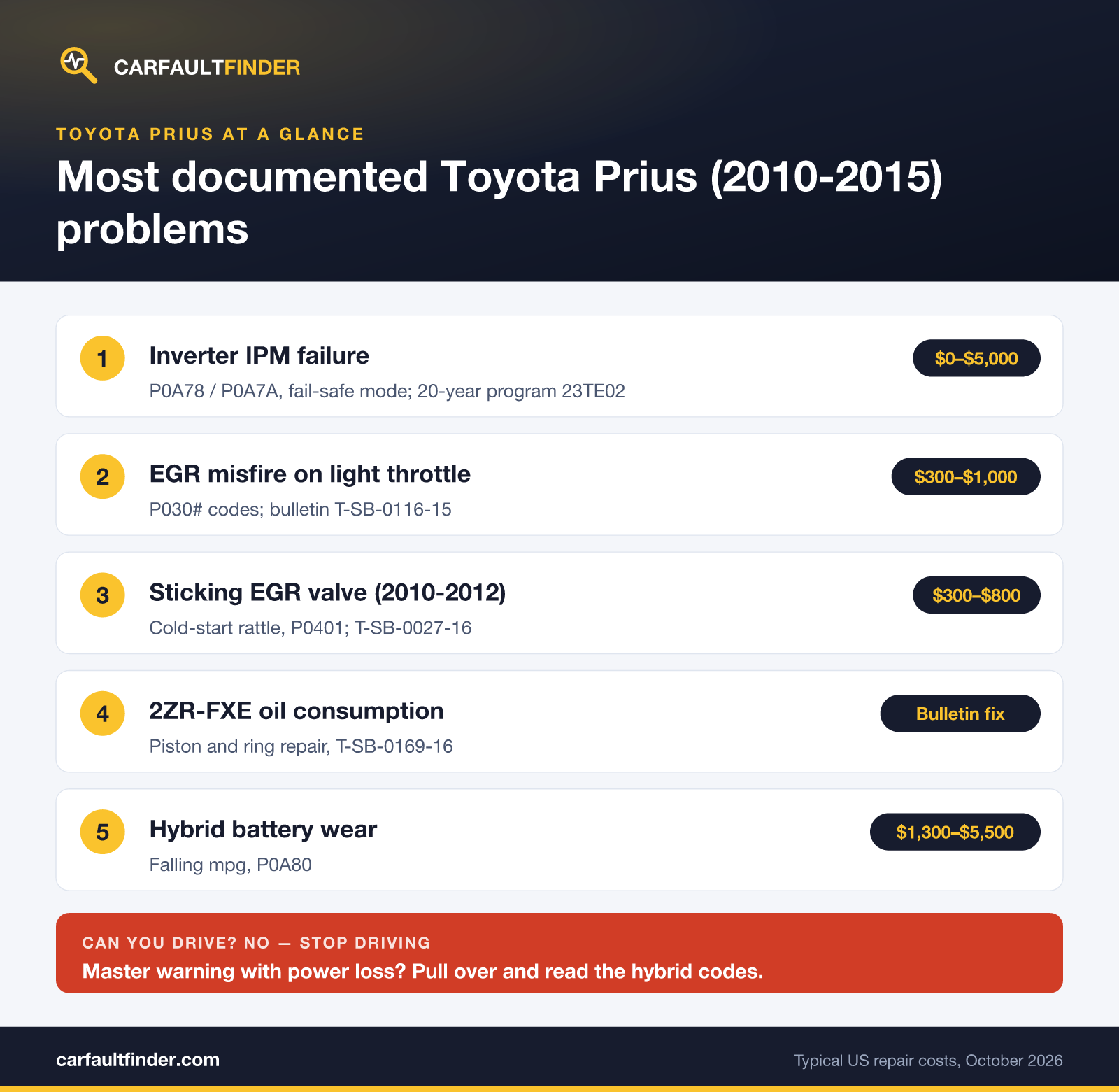
The most documented 2010-2015 Toyota Prius problem is inverter IPM failure, which sets P0A78 or P0A7A, lights the master warning and drops the car into reduced-power fail-safe mode. Recalls updated the software; program 23TE02 covers the IPM and inverter for 20 years with no mileage limit. EGR misfire and oil use follow.
- Recall 18V-684 covers 807,329 2010-2014 Prius and 2012-2014 Prius V; recall 20V-369 adds 266,638 later vehicles.
- Customer Confidence Program 23TE02 covers the IPM and inverter for 20 years with unlimited mileage for P0A78 or P0A7A.
- Toyota bulletin T-SB-0116-15 fixes EGR-related misfire on 2010-2015 Prius with a revised intake manifold.
- A charge light alone does not prove an inverter failure — read the hybrid codes first.
- Orange high-voltage cables are not for owners to touch; inverter and battery work is dealer or specialist work.
- Which Toyota Prius Does This Guide Cover?
- What Is the Most Common Toyota Prius Problem?
- Which Recalls and Warranty Programs Cover the Prius Inverter?
- Is It the Inverter or the Inverter Coolant Pump?
- Why Does a 2010-2015 Prius Misfire With the EGR Active?
- Does the Prius 2ZR-FXE Engine Burn Oil?
- How Long Does a Prius Hybrid Battery Last?
- How Do You Check a Prius for These Problems?
- What Does It Cost to Fix Common Prius Problems?
- Can You Keep Driving a Prius in Fail-Safe Mode?
- Frequently Asked Questions
- Related Guides
Which Toyota Prius Does This Guide Cover?
The Toyota Prius covered here is the third-generation (XW30) car sold in North America for 2010 to 2015, with the 1.8-litre 2ZR-FXE petrol engine, a nickel-metal hydride hybrid battery and an inverter feeding two motor/generators. The Prius V wagon and Prius Plug-in share most of this hardware.
| Model | Powertrain | Most documented issue |
|---|---|---|
| Prius (Gen3), 2010-2015 | 2ZR-FXE hybrid | Inverter IPM failure, EGR-related misfire, oil consumption |
| Camry | 2AZ-FE petrol (2007-2011) | Oil consumption — see our Toyota Camry common problems |
What Is the Most Common Toyota Prius Problem?
The most documented Toyota Prius problem for 2010-2015 is failure of the Intelligent Power Module (IPM) inside the hybrid inverter. Toyota found that software controlling the IPM’s boost converter could overheat specific transistors under high load, such as accelerating at motorway (highway) speed, and damage them over time.
When the IPM fails, a dealer scan typically finds one of two hybrid codes:
- P0A78 — Drive Motor “A” Inverter Performance: the inverter feeding the main drive motor is not behaving as commanded.
- P0A7A — Generator Inverter Performance: the same check for the inverter section serving the generator.
Recognise it by: the red master warning triangle, the check engine light and a “Check Hybrid System” message appearing together, followed by much reduced power (fail-safe mode). Occasionally the hybrid system shuts down while driving; steering and brakes keep working.
The red battery (charge) symbol on a Prius refers to 12-volt charging from a DC-DC converter, not an alternator, so a charge light on its own does not prove an IPM failure; see battery light on while driving for that symptom.
Which Recalls and Warranty Programs Cover the Prius Inverter?
Three NHTSA safety recalls and a series of Toyota coverage programs address the Prius inverter IPM. The recalls change software and, if the inverter has already failed with the related codes, repair or replace it free. The coverage programs pay for IPM failures that happen later.
| Campaign | Vehicles | What it does |
|---|---|---|
| Recall 14V-053 (Toyota E0E), 2014 | 2010-2014 Prius | ECU software update; later folded into J0V |
| Recall 18V-684 (Toyota J0V), 2018 | 2010-2014 Prius, 2012-2014 Prius V — 807,329 vehicles | Software so the car enters fail-safe instead of shutting down; failed inverters replaced |
| Recall 20V-369 (20TA10 / 20TB10), 2020 | 2013-2015 Prius, 2014-2017 Prius V not in 18V-684 — 266,638 vehicles | Same remedy |
| Programs ZE3, ZF5, 20TE10 | Prius and Prius V by year | IPM/inverter coverage, 15 years with unlimited mileage |
| Customer Confidence Program 23TE02 (2023) | 2010-2015 Prius, 2012-2017 Prius V — about 1,088,000 vehicles | Settlement: IPM and inverter covered 20 years, unlimited miles, for P0A78/P0A7A or thermal damage |
Coverage runs from the date of first use, applies only at Toyota dealers and follows the VIN to later owners. The settlement was approved in February 2023.
Is It the Inverter or the Inverter Coolant Pump?
An IPM failure and an inverter coolant pump failure are different faults with different codes. IPM failure sets P0A78 or P0A7A because the power electronics themselves fail, while a weak or stopped electric pump in the separate inverter cooling loop usually sets P0A93, Inverter “A” Cooling System Performance.
A failed pump can overheat the inverter, which is why 23TE02 also covers IPM damage from a thermal event regardless of code. But a $150-$400 pump does not fix a P0A78 — that code describes the module, not the coolant flow.
Why Does a 2010-2015 Prius Misfire With the EGR Active?
A 2010-2015 Prius can misfire during light acceleration because carbon from the exhaust gas recirculation (EGR) system builds up in the intake manifold and EGR passages. Toyota bulletin T-SB-0116-15 describes a rough-running condition with misfire codes P030# while EGR is active, and its fix is a revised intake manifold and EGR pipe gasket.
A second bulletin, T-SB-0027-16, covers 2010-2012 Prius with a sticking, carbon-fouled EGR valve: rough idle or a tapping noise from the transaxle after a cold start, sometimes with code P0401. See our P0401 code guide.
- Recognise it by: shudder under gentle throttle at 25-45 mph, a flashing or steady check engine light, rattle after a cold soak.
- Usual fix: the bulletin repair, or shop cleaning of the EGR valve, cooler and passages. Independent shops link a clogged EGR cooler to head gasket failure, but Toyota has no bulletin on it — treat coolant loss with a misfire as a reason for prompt inspection.
Does the Prius 2ZR-FXE Engine Burn Oil?
The Prius 2ZR-FXE engine can consume oil, and Toyota documented it: bulletin T-SB-0168-16 sets an oil consumption inspection, and T-SB-0169-16 (November 2016) replaces the pistons and piston rings on affected 2010-2014 Prius, Prius V and Prius Plug-in vehicles built before a production change.
A hybrid engine can run low without obvious symptoms. Check the level every few fuel fills using our how to check engine oil level properly guide, and ask a dealer about the inspection if you add more than about a quart (1 litre) between changes.
How Long Does a Prius Hybrid Battery Last?
A Prius hybrid battery commonly lasts 10 to 15 years or roughly 150,000 to 200,000 miles, but heat, long periods parked and short trips shorten that. On 2010-2015 cars the original 8-year/100,000-mile hybrid warranty (10 years/150,000 miles in some emissions states) has expired, so a failing pack is now an owner cost.
Recognise it by: the petrol engine running far more often, the battery gauge swinging quickly between empty and full, falling fuel economy and, eventually, a master warning with code P0A80 (Replace Hybrid Battery Pack). Options are a new Toyota pack or a remanufactured one — compare warranty length, not just price.
How Do You Check a Prius for These Problems?
Checking a Prius for its known problems starts with a VIN recall lookup and a scan that can read hybrid codes. Many basic engine-only readers miss P0A78, P0A7A and P0A80, so a dealer’s Techstream or a hybrid-capable scan tool is worth more than guessing from warning lamps.
| Symptom and condition | Most likely cause | Check first |
|---|---|---|
| Master warning + check engine, sudden low power | Inverter IPM failure (P0A78/P0A7A) | Hybrid code scan; recall and 23TE02 status |
| Shudder on light throttle, misfire codes | EGR carbon in intake (T-SB-0116-15) | Misfire counters; EGR passages |
| Rough idle or rattle after a cold start | Sticking EGR valve (T-SB-0027-16) | P0401; EGR valve |
| Oil low between changes, no drips | 2ZR-FXE oil consumption | Dealer oil inspection (T-SB-0168-16) |
| Engine runs constantly, mpg falling | Ageing hybrid battery | Block voltage test; P0A80 |
1. Run the VIN through a recall check
Use NHTSA’s lookup or a Toyota dealer to confirm recall work and 23TE02 eligibility.
2. Record the hybrid codes before clearing
The code decides which coverage applies.
3. Leave the high-voltage parts alone
Orange high-voltage cables — do not touch them, and do not open the inverter or battery.
What Does It Cost to Fix Common Prius Problems?
Fixing common Toyota Prius problems costs anything from nothing for recall and covered IPM work to several thousand dollars for an out-of-coverage inverter or hybrid battery. These are typical US ranges, parts and labour together.
| Repair | Typical cost |
|---|---|
| Recall software; IPM/inverter under 23TE02 | $0 at a Toyota dealer |
| Inverter assembly, not covered | $2,500 – $5,000 |
| Inverter coolant pump | $150 – $400 |
| EGR valve, cooler and passage cleaning | $300 – $800 |
| Intake manifold per T-SB-0116-15, out of warranty | $500 – $1,000 |
| Hybrid battery, remanufactured, installed | $1,300 – $2,500 |
| Hybrid battery, new Toyota pack at a dealer | $3,500 – $5,500 |
Typical US costs, October 2026 — varies by vehicle and region.
What doesn’t work: buying a used inverter before checking 23TE02 coverage, or repeatedly clearing hybrid codes.
Can You Keep Driving a Prius in Fail-Safe Mode?
You should not keep driving a Prius in fail-safe mode beyond reaching a safe place or the nearest dealer. Reduced power makes joining fast traffic dangerous, and an IPM fault can progress to a hybrid shutdown. 23TE02 also includes loaner and towing support.
Behaviour is similar to a car stuck in limp mode, but on a hybrid the fault must be read before driving on. For other makes, see our car brands section.
If the master warning lights with sudden power loss, pull over safely and have the hybrid codes read. IPM and inverter repairs are usually covered free under Toyota program 23TE02.
Take the Prius to a Toyota dealer or hybrid specialist if the master warning lights with reduced power, the hybrid system shuts down, or a scan shows P0A78, P0A7A or P0A80. The inverter and hybrid battery run at several hundred volts: orange high-voltage cables — do not touch them, and never open the inverter or battery case yourself. This is beyond a driveway job.
Frequently Asked Questions
Is the Prius inverter covered under warranty?
Often, yes. Under Customer Confidence Program 23TE02, Toyota covers the IPM and inverter on 2010-2015 Prius and 2012-2017 Prius V for 20 years from first use with no mileage limit, when P0A78 or P0A7A is detected or the IPM failed from a thermal event. Work must be done at an authorised Toyota dealer.
What are the symptoms of a bad Prius inverter?
A failing Prius inverter IPM usually turns on the red master warning triangle and check engine light with a Check Hybrid System message, then drops the car into fail-safe mode with much reduced power. In some cases, the hybrid system shuts down while driving. A dealer scan typically finds P0A78 or P0A7A.
Does a Prius battery light mean the inverter has failed?
Not on its own. The red battery symbol on a Prius relates to 12-volt charging from the DC-DC converter, not the IPM. An IPM failure usually lights several lamps at once, including the master warning and check engine light. Read the hybrid codes before assuming the inverter is the cause.
Which Prius years should I avoid?
The 2010-2012 Prius carries the most documented problems: IPM software recalls, EGR misfire and sticking EGR valve bulletins, oil consumption repairs and, for 2010 only, ABS recall 10V-039 for inconsistent braking on rough surfaces. A well-maintained example with completed recalls can still be sound; check the VIN first.
How much does a Prius hybrid battery replacement cost?
Typical US costs in October 2026 run about $1,300 to $2,500 for a remanufactured pack installed by an independent shop, and about $3,500 to $5,500 for a new Toyota pack at a dealer. Prices vary by region; compare warranty length and whether the old pack’s core credit is included.
Can I replace a Prius inverter myself?
No, this is not a home repair. The inverter connects to the hybrid battery through high-voltage cables, and stored energy can remain after the car is switched off. Dealer work is usually free under the 23TE02 program anyway, so a DIY attempt only adds risk and cost.
Why does my Prius shudder when accelerating gently?
On 2010-2015 Prius models, a shudder under light throttle often comes from carbon built up by the EGR system, which causes misfires. Toyota bulletin T-SB-0116-15 addresses this with a revised intake manifold. A shop should confirm the misfire codes and EGR condition before replacing coils or plugs.