A car that won’t start after getting gas usually has an EVAP purge valve stuck open. Refuelling fills the charcoal canister with petrol vapour, and a leaking valve lets it flood the engine, causing a long, rough crank. A new purge valve typically costs $100-$300 fitted. A no-crank or click instead points to the battery or shifter.
- A purge valve replacement typically costs $100-$300 fitted and cures most no-starts that happen only after refuelling.
- A 5-15 second crank followed by a rough idle after fill-ups points to the EVAP system, not the fuel pump.
- Stopping at the first click of the pump nozzle protects the charcoal canister, a $300-$900 part.
- Ford recall 18S32 covers stuck-open purge valves on 2012-2018 Focus 2.0L cars — check your VIN.
- Why Won’t My Car Start After Getting Gas?
- What Are the Most Common Causes, Most Likely First?
- How Does a Stuck-Open Purge Valve Stop the Engine Starting?
- Does Topping Off the Tank Cause Starting Problems?
- How Do You Narrow It Down?
- What Do the Possible Fixes Cost?
- Can You Keep Driving?
- When Should You See a Mechanic?
- Frequently Asked Questions
- Related Guides
Why Won’t My Car Start After Getting Gas?
A car that won’t start after getting gas, when it started perfectly before the fill-up, most often has an EVAP purge valve stuck open. Refuelling pushes a burst of petrol vapour into the charcoal canister, and a leaking valve lets that vapour flood the intake. How the engine refuses to start narrows it down:
| What happens at the key | What it usually points to |
|---|---|
| Cranks 5-15 seconds, then starts rough; after most fill-ups | EVAP purge valve stuck open |
| Same long crank, mainly after topping off past the first click | Liquid fuel in the canister plus a weak purge valve |
| Cranks normally but never fires; tank was nearly empty | Fuel pump failed or struggling |
| Starts, then runs badly or dies; new station | Wrong or contaminated fuel |
| Clicks, cranks slowly or does nothing | Battery or shifter — the fill-up is a coincidence |
If it cranks but never catches at other times too, see our guide to a car that cranks but won’t start.
What Are the Most Common Causes, Most Likely First?
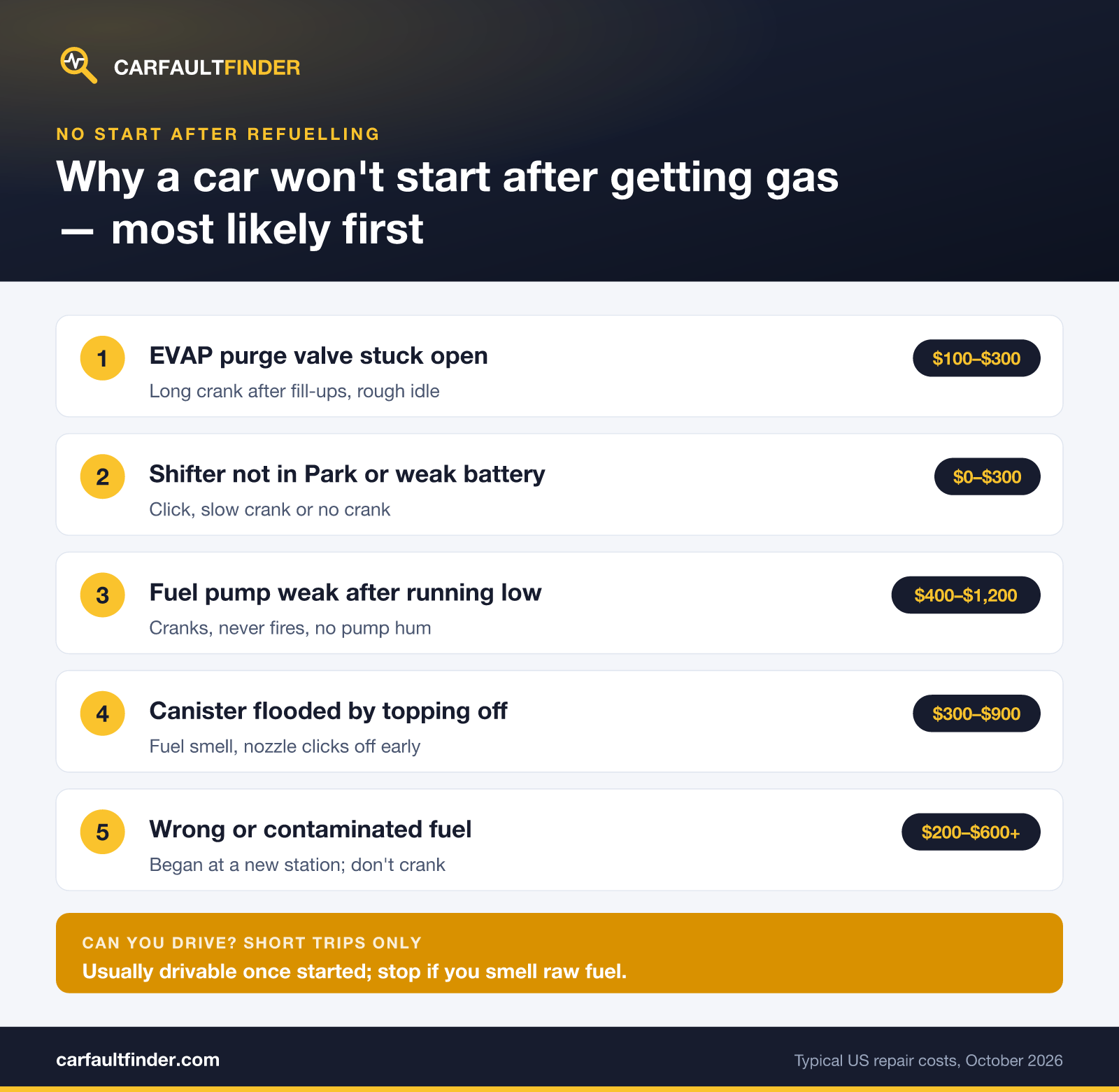
The causes of a no-start after refuelling are ranked here by how often they turn out to be the answer, cheapest and most common first. The purge valve leads because the symptom is so specific to fill-ups.
1. EVAP purge valve stuck open
Recognise it by: a long crank only after refuelling, a lumpy idle for the first minute and sometimes an EVAP code such as P0441. Usual fix: a new purge valve (purge solenoid), typically $100-$300 fitted.
2. Shifter not fully in Park, or a weak battery
Recognise it by: no crank, a single click or a slow crank. Usual fix: press the shifter fully into Park and retry; test or jump start a weak battery ($150-$300 to replace).
3. Fuel pump weak or failed after running low
Recognise it by: normal cranking with no firing, no pump hum at key-on, and a nearly empty tank before the fill-up. In-tank pumps are cooled by fuel, so a tired pump often quits after a low-fuel run. Usual fix: pump module $400-$1,200, sometimes just a relay or fuse; a circuit fault may set P0230.
4. Charcoal canister flooded by topping off
Recognise it by: purge-valve symptoms plus a petrol smell at the rear and a nozzle that clicks off early. Usual fix: canister and purge valve, about $300-$900.
5. Wrong or contaminated fuel
Recognise it by: trouble right after filling at a new station, misfires or stalling within minutes. Usual fix: stop cranking and have the tank drained and flushed, typically $200-$600.
How Does a Stuck-Open Purge Valve Stop the Engine Starting?
A stuck-open purge valve stops the engine starting by making the mixture far too rich at the moment of cranking. The valve is a computer-controlled gate between the charcoal canister and the intake, and it should stay shut until the engine is warm and running.
US petrol cars since the early 2000s have onboard refuelling vapour recovery (ORVR): vapour pushed out of the tank while you fill up is stored in the canister, so right after a fill-up the canister is loaded. If the valve leaks, cranking vacuum pulls that vapour into the intake on top of the computer’s normal starting fuel. The plugs get wet and the engine won’t fire until air clears it. The error is rich, not lean, which is why P0172 sometimes appears too.
Does Topping Off the Tank Cause Starting Problems?
Topping off the tank after the nozzle clicks off can contribute to starting problems after getting gas, usually indirectly. Extra fuel can reach the vapour lines and soak the charcoal canister, which is built for vapour, not liquid. A soaked canister feeds far more fuel through a leaking purge valve and can carry debris that helps the valve stick.
One occasional top-off is unlikely to do harm. Stop at the first click, and if the long crank appears only after full, topped-off tanks, tell whoever diagnoses the car — that pattern points straight at the EVAP system.
How Do You Narrow It Down?
Narrowing down a no-start after refuelling takes about 30-60 minutes with an OBD-II scanner, a multimeter and ideally a hand vacuum pump. The order matters: free checks first, then codes, then the purge valve itself. Work with the engine off and cool, and well away from the pump forecourt.
1. Rule out the simple things (2 minutes)
Press the shifter into Park, foot on the brake, and retry. With clicks or no crank, check the battery: 12.4-12.7 V at rest is healthy, below 12.2 V points to the battery. See car won’t start but lights work.
2. Try a clear-flood start (1 minute)
On many fuel-injected engines, holding the accelerator to the floor while cranking cuts injection so air can clear a flooded engine; check the owner’s manual first. Crank no more than 10-15 seconds, then rest about 30 seconds. If it fires this way, the engine was over-rich.
3. Listen for the fuel pump (1 minute)
Switch to On without cranking and listen near the rear seat for a 2-3 second hum. Silence points to the pump, its fuse or its relay.
4. Read the codes (5 minutes)
P0441 (incorrect purge flow) or P0496 (high purge flow) supports the purge valve; P0172 shows the extra fuel; P0230 points to the pump circuit; P0455 usually just means the fuel cap was left loose. On Ford vehicles, P1450 means the system could not bleed up fuel tank vacuum, which a stuck purge valve can cause; other makes use P1450 differently, so confirm with a manufacturer-code scanner. A clean scan doesn’t clear the valve.
5. Test the purge valve (15-30 minutes)
The valve is normally closed with the power off. Disconnect its canister-side hose and apply vacuum with a hand pump: it should hold. If it bleeds down, the valve leaks. This is the vapour side; never disconnect a line carrying liquid fuel.
What Do the Possible Fixes Cost?
Fixing a car that won’t start after getting gas is usually a modest repair, because the most likely cause is a small, accessible valve. Typical US costs, October 2026 — varies by vehicle and region:
| Confirmed cause | Fix | Typical cost (parts + labour) |
|---|---|---|
| Purge valve stuck open | Replace valve (part about $25-$120) | $100-$300 |
| Canister saturated with fuel | Replace canister, usually with valve | $300-$900 |
| Weak battery | Replace battery | $150-$300 |
| Fuel pump relay or fuse | Replace, then find why it failed | $10-$150 |
| Failed fuel pump or module | Replace pump assembly | $400-$1,200 |
| Wrong or contaminated fuel | Drain tank, flush, new filter | $200-$600+ |
What doesn’t work: fuel additives (they cannot unstick a valve), clearing the code, a new fuel pump “because it won’t start”, or a new fuel cap when the code is a purge-flow code. For filter symptoms see how to tell if your fuel filter needs replacing.
Can You Keep Driving?
You can usually keep driving a car that starts after a long crank following fill-ups, if it then runs smoothly and the check engine light is steady. A stuck-open purge valve is mainly a starting and emissions nuisance, but fix it within a few weeks.
Stop and get help if you smell raw petrol, see a leak, the light is flashing or the engine stalls on the move — a stall while driving is a safety issue. If you suspect wrong fuel, don’t restart; have it towed.
When Should You See a Mechanic?
See a mechanic for a car that won’t start after getting gas when you smell fuel, when a new purge valve doesn’t cure the long crank, when the fuel pump is silent, or when you suspect wrong fuel. Smoke and fuel pressure tests need shop equipment. More in our starting problems section.
Usually fine once it starts and runs smoothly, but fix it within weeks. Stop if you smell raw fuel, the light flashes or you suspect wrong fuel.
Petrol and its vapour are highly flammable. Do not open fuel lines, disconnect the fuel pump or drain the tank yourself, and never crank repeatedly while you can smell raw fuel. A strong fuel smell, a visible leak, suspected wrong fuel or a pump that won’t run is beyond a driveway job: have the car checked, or towed, by a mechanic.
Frequently Asked Questions
Why is my car hard to start only after I fill up?
A car that is hard to start only after refuelling usually has an EVAP purge valve stuck open. Filling the tank loads the charcoal canister with vapour, and a leaking valve lets it flood the intake during cranking. The engine runs rich, cranks for several seconds, then starts rough and settles.
Can a bad gas cap stop a car from starting?
A bad or loose gas cap rarely stops a car from starting. It usually just causes an EVAP leak code such as P0455 or P0442 and a steady check engine light. If the car won’t start after getting gas, look at the purge valve, battery, shifter position and fuel pump before the cap.
Should I press the gas pedal when starting after refuelling?
On many fuel-injected cars, holding the accelerator to the floor while cranking activates a clear-flood mode that cuts injection and helps an over-rich engine start. Check your owner’s manual first, crank for no more than 10-15 seconds, and treat the need for this as a symptom to fix, not a routine.
Is there a recall for a stuck purge valve?
Yes, for one model. Ford recall 18S32 (NHTSA 18V-735) covers about 1.28 million 2012-2018 Ford Focus cars with 2.0L engines whose purge valve can stick open, risking a deformed fuel tank and loss of power. The dealer repair is free. Other makes treat a stuck purge valve as an ordinary repair; check your VIN.
Will a bad purge valve drain the battery?
A bad purge valve does not drain the battery directly, but the long cranking it causes after every fill-up works the battery and starter hard. An ageing battery can fail sooner as a result, so test the battery at about 12.4-12.7 V at rest once the purge valve is fixed.
Can bad gas from a station stop my car starting?
Bad gas can stop a car starting, but it is rarer than a purge valve fault. Water or heavy contamination usually causes misfires and stalling soon after the fill-up rather than a clean no-start. Keep the receipt, avoid repeated cranking and have a sample checked if several cars are affected.