P0730 means the transmission computer has measured a gear ratio that doesn’t match the gear it commanded — the transmission is slipping or a speed signal is wrong. Check fluid level and condition first, then the input and output speed sensors. Repairs range from about $20 for fluid to $2,500–$6,000 for a rebuild.
- P0730 sets when input-to-output shaft speed differs from the expected ratio, often by about 5% for several seconds.
- Repairs run from about $20 for a fluid top-up to $2,500–$6,000 for a rebuild or replacement unit (October 2026).
- Check the fluid first: low or burnt fluid is the most common, cheapest cause.
- Gear codes P0731–P0735 and sensor codes P0715/P0720 narrow down the fault.
- Drive only gently and briefly: a slipping transmission can lose drive suddenly and wears faster with every mile.
- What Does P0730 Mean?
- What Are the Symptoms of P0730?
- What Causes P0730?
- How Is P0730 Different From P0731–P0735?
- How Do You Diagnose P0730?
- How Do You Fix P0730 and What Does It Cost?
- Can I Drive With P0730?
- When Should You See a Mechanic for P0730?
- What Does P0730 Mean on a CVT?
- Frequently Asked Questions
- Related Guides
What Does P0730 Mean?
P0730 is the generic OBD-II code for “Incorrect Gear Ratio”. The transmission computer compares how fast the input shaft and the output shaft are turning, works out the ratio, and sets P0730 when that ratio doesn’t match the gear it commanded. In plain terms, the transmission is slipping or is in a different gear than it should be.
Every gear has a fixed ratio; first gear on a typical six-speed is about 4:1, so the input shaft turns roughly four times per output turn. The transmission control module (TCM, or the PCM on many cars) divides input (turbine) speed by output speed and checks the answer against the ratio it expects. If it drifts outside a tolerance for a set time, the code logs. One published GM example sets it when the ratio is more than about 5% off for over seven seconds. P0700 often appears too, telling the engine computer the transmission has stored a fault.
What Are the Symptoms of P0730?
P0730 almost always comes with something you can feel, because a wrong gear ratio means the transmission is not holding the gear properly. Which gear, hot or cold, light or heavy throttle — that pattern is the best early clue to the cause.
- Engine revs flare without the car speeding up, especially on a shift or uphill — classic transmission slipping.
- Harsh, late or delayed shifts, or hunting between two gears.
- Limp mode: stuck in one gear (often 2nd or 3rd), as covered in car stuck in limp mode.
- Shudder at steady speeds around 30–50 mph if the torque converter clutch slips.
- Poorer fuel economy and a hot, burnt smell from overheated fluid.
Sometimes the code appears after one hard launch or towing on a hot day with no other symptom. Investigate anyway: slipping creates heat, and heat speeds up wear.
What Causes P0730?
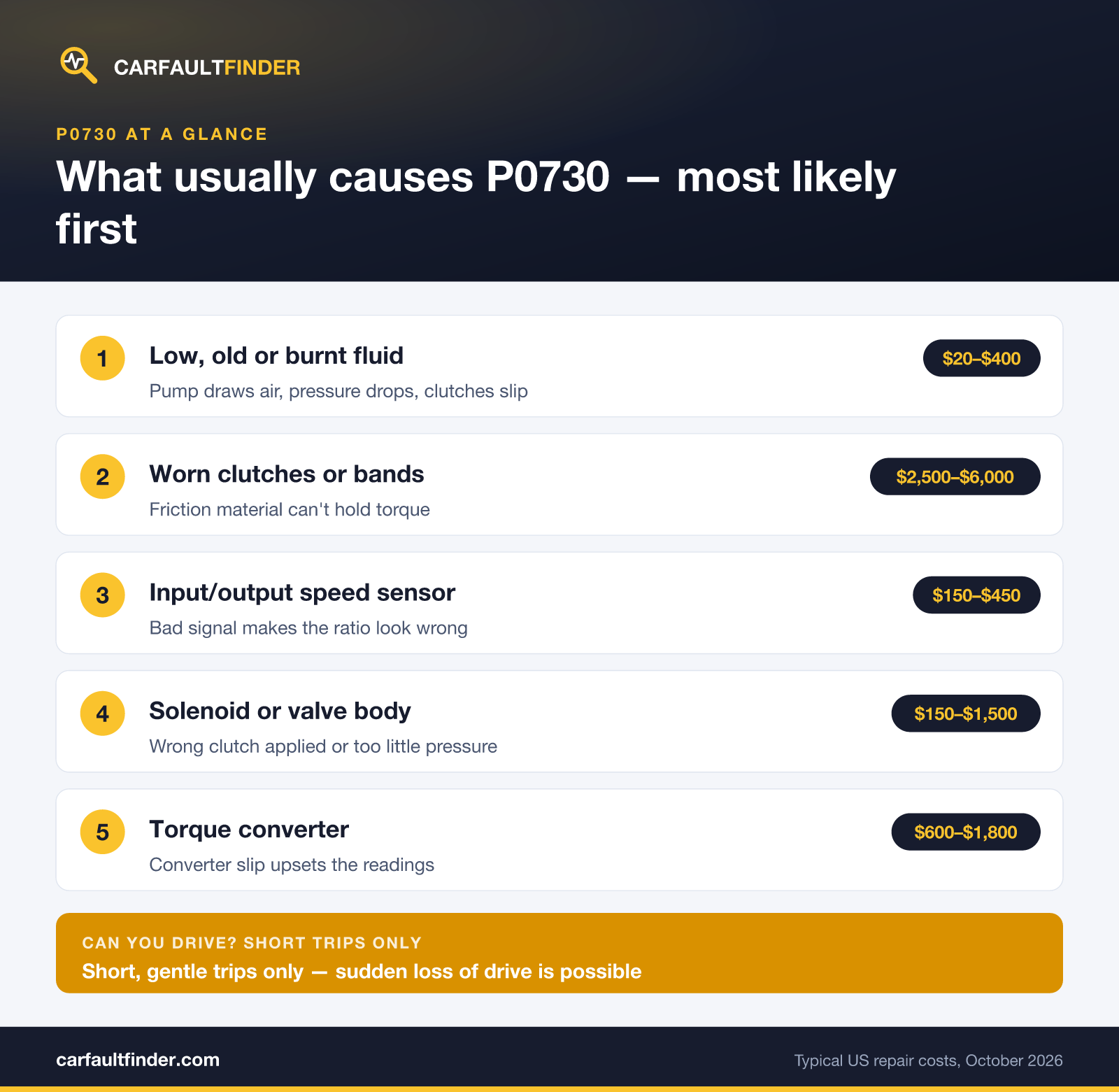
P0730 is caused by anything that lets clutches or bands slip, anything that commands the wrong gear, or a speed signal that makes a healthy transmission look wrong. Check them roughly in this order — the most common and cheapest come first.
- Low, old or burnt fluid. Low fluid lets the pump draw air, pressure drops and clutches slip; burnt fluid has lost its friction properties. Fix: correct the level or service the fluid, $20–$400.
- Worn clutch packs or bands. The most common internal cause on high-mileage units, usually affecting one gear first. Fix: rebuild or replacement, $2,500–$6,000.
- Input or output speed sensor or wiring. A signal dropout makes the ratio look wrong even when the gears are fine; look for P0715 or P0720 alongside. Fix: $150–$450.
- Shift solenoids, pressure control solenoid or valve body. The wrong clutch applies, or too little pressure. Fix: $150–$1,500.
- Torque converter. A failing converter can upset ratio readings. Fix: $600–$1,800.
- Mechanical damage or TCM software. Broken planetary gears or a failed one-way clutch need a rebuild; some makers have issued software updates for ratio logic ($100–$250 reflash).
How Is P0730 Different From P0731–P0735?
P0730 is the general “something’s wrong with the ratio” code, while neighbouring codes narrow the problem down. A gear-specific code points at the clutch for that gear; a sensor code points away from the gearbox internals altogether.
| Code | Meaning | What it adds to P0730 |
|---|---|---|
| P0700 | Transmission control system malfunction | A flag only; the TCM holds its own code |
| P0715 / P0720 | Input / output speed sensor circuit | Ratio may be miscalculated — check sensors first |
| P0731 | Gear 1 incorrect ratio | Slipping in 1st |
| P0732 | Gear 2 incorrect ratio | Slipping in 2nd |
| P0733 | Gear 3 incorrect ratio | Slipping in 3rd |
| P0734 | Gear 4 incorrect ratio | Slipping in 4th, often overdrive |
| P0735 | Gear 5 incorrect ratio | Slipping in 5th |
| P0736 | Reverse incorrect ratio | Slipping in reverse only |
Six-speed and larger units use further codes, such as P0729 for 6th. Which clutch serves which gear depends on the design, so use the service manual’s clutch application chart. P0740/P0741 add the torque converter clutch; P0748 points to the pressure control solenoid.
How Do You Diagnose P0730?
Diagnosing P0730 starts with the fluid and the speed signals, because both are cheap to check and both can set the code on a transmission that is mechanically fine. Allow one to two hours with a scan tool that shows transmission live data.
1. Record every code and freeze frame
Note speed, commanded gear, fluid temperature and throttle. A code set at 70 mph with hot fluid tells a different story from one set pulling away cold.
2. Check fluid level and condition
Follow the maker’s procedure; many modern units have no dipstick and are checked at a set fluid temperature, often around 35–45°C (95–113°F). Our transmission fluid check guide covers both types. Healthy fluid is red and translucent; dark, burnt-smelling fluid or metallic glitter suggests wear.
3. Graph input and output speed
On a road test, a smooth input trace that drops neatly at each shift means healthy sensors; spikes to zero point to a sensor, connector or wiring fault.
4. Compare the ratio in each gear
A ratio correct in every gear but one narrows the fault to the clutch or band applied in that gear.
5. Check bulletins, then pressure
Ask whether a software update or service bulletin applies, then have a specialist run a line pressure test.
How Do You Fix P0730 and What Does It Cost?
Fixing P0730 can cost anything from a fluid top-up to a replacement transmission, which is why the diagnosis matters more than the code. Typical US costs, October 2026 — they vary by vehicle, transmission type and region.
| Cause found | Repair | Typical cost |
|---|---|---|
| Fluid low | Fix leak, correct level | $20–$250 |
| Fluid old or burnt, little wear | Drain-and-fill, filter where fitted | $120–$400 |
| Speed sensor or wiring | Replace sensor or repair connector | $150–$450 |
| Solenoid | Replace solenoid | $150–$600 |
| Valve body or solenoid pack | Replace or recondition | $500–$1,500 |
| Worn clutches or bands | Rebuild or remanufactured unit | $2,500–$6,000 |
Eight- and ten-speed automatics and CVTs often cost more, and a new dealer unit can exceed $7,000. Compare warranties, not only prices.
Old fluid on a high-mileage unit: if it is still red and smells normal, a gentle drain-and-fill with the exact specified fluid is generally low risk. If it is dark, burnt or full of debris, the clutches are probably already worn — fresh fluid won’t save them, and a pressurised flush is best avoided. See how often to flush your transmission fluid.
What doesn’t work: clearing the code and hoping, “stop slip” additives on worn friction material, or replacing a sensor when the live data looks clean.
Can I Drive With P0730?
You can usually drive a short distance with P0730 to reach a shop, but not normally. A slipping transmission builds heat fast, and every mile of slipping wears the clutches further, turning a fluid or solenoid repair into a rebuild.
The bigger risk is sudden loss of drive or an unexpected downshift when pulling into traffic or overtaking. In limp mode, keep speeds low, avoid towing and heavy throttle, and take the shortest route to a repair.
If the engine revs freely and the car stops accelerating while you’re moving, signal, move off the road where it is safe and stop. Don’t keep revving to force the transmission to pick up the gear.
When Should You See a Mechanic for P0730?
A transmission specialist is the right call for P0730 once the fluid level is correct and the speed data looks clean, because pressure testing, valve body work and internal inspection need special tools. Go sooner if the car slips, flares or refuses to shift.
Ask to see the scan data and the measured ratio, not just the code. Our transmission guides explain the options before you agree to a rebuild.
What Does P0730 Mean on a CVT?
P0730 on a continuously variable transmission (CVT) means the pulley ratio differs from the ratio the computer is aiming for. A CVT has no fixed gears — two variable pulleys and a steel belt or chain create the ratio — so the same input-versus-output check applies.
Likely causes are degraded or incorrect CVT fluid, belt or chain slip, worn pulleys, a valve body or pressure solenoid fault, or a speed sensor. Some makers have offered extended CVT warranties on certain models, so check with a dealer using your VIN before paying for repairs.
Short, gentle trips to a repair shop only. Avoid motorways, towing and hard acceleration; stop if the engine revs flare and the car stops pulling.
See a transmission specialist if the fluid level is correct and P0730 returns, if the car slips, flares or sticks in one gear, or if the fluid is dark, burnt or full of debris. Line pressure testing and internal repairs need special tools. Pull over safely if drive is lost while moving.
Frequently Asked Questions
Can low transmission fluid cause P0730?
Yes. Low transmission fluid is one of the most common causes of P0730. When the level drops, the pump can draw air, line pressure falls and the clutches slip, so the measured gear ratio drifts from the commanded one. Check the level using the maker’s procedure before buying parts, and find the leak that caused it.
Can a bad speed sensor cause P0730?
A faulty input or output speed sensor can set P0730 because the computer calculates the ratio from those two signals. If a sensor drops out, the ratio looks wrong even when the gears are fine. A speed sensor fault usually also sets P0715 or P0720, and live data shows an erratic or missing signal.
Will a transmission fluid change fix P0730?
A fluid change fixes P0730 only when old or wrong fluid is the cause and the clutches are still healthy. If the clutches or bands are worn, fresh fluid won’t restore them, and the code returns. Use the exact fluid the maker specifies, and check the scan data after a road test to confirm the fix.
How serious is a P0730 code?
P0730 is a serious code because it means the transmission is not holding the commanded gear. Left alone, slipping creates heat and wear that can turn a solenoid or fluid repair into a $2,500 to $6,000 rebuild. It can also cause a sudden loss of drive in traffic, so get it diagnosed promptly.
Is P0730 the same as P0700?
No. P0700 is a general flag telling the engine computer that the transmission control module has stored a fault. P0730 is a specific fault: the measured gear ratio is wrong. The two often appear together, and the specific code, here P0730, is the one that guides the diagnosis and repair.
How much does it cost to fix P0730?
Fixing P0730 typically costs $20 to $400 when the cause is fluid, $150 to $600 for a sensor or solenoid, $500 to $1,500 for a valve body, and $2,500 to $6,000 for a rebuild or remanufactured transmission, based on typical US prices in October 2026. CVTs and eight- or ten-speed units often cost more.