The low coolant warning light means the float sensor in the expansion tank reads coolant below MIN. Check the level on a cold engine: if it is low, top up and look for a leak or air after a repair; if it is between MIN and MAX, the $60-$200 level sensor, float or connector is usually at fault. Stop if the temperature gauge climbs.
- Check the level only on a cold engine; a hot system is pressurised and can spray coolant above boiling point.
- A level below MIN means real coolant loss; a level between MIN and MAX with the light on points to the sensor, float or wiring.
- Most fixes cost $15-$450 (top-up, cap, sensor, tank or hose); internal leaks can reach $3,500.
- The low coolant light reads level in the tank; the red temperature light reads engine temperature, and both together mean stop.
- What Does the Low Coolant Warning Light Mean?
- Start Here: Is It the Sensor or a Real Leak?
- What Causes the Low Coolant Light to Come On?
- Low Coolant Light vs Temperature Warning Light: What Is the Difference?
- What Should You Do When the Low Coolant Light Comes On?
- How Do You Narrow It Down?
- How Much Does It Cost to Fix a Low Coolant Light?
- Can You Keep Driving With the Low Coolant Light On?
- When Should You See a Mechanic?
- Frequently Asked Questions
- Related Guides
What Does the Low Coolant Warning Light Mean?
The low coolant warning light means a level sensor in the coolant expansion tank has detected coolant below its minimum mark. It is a level warning, not a temperature warning: the engine may still be at normal temperature. Either the coolant really is low, usually from a leak, or the sensor is giving a false reading.
The symbol is usually an amber tank with wavy lines or a “Coolant level low” message. Inside the translucent expansion tank, a float carrying a small magnet rides on the coolant. When the level drops, the float moves away from a reed switch in the sensor stem, the switch changes state and the light comes on.
Not every car has this light. Level sensors are common on European makes such as Volkswagen, Audi, BMW, Mercedes-Benz and Volvo, and on many diesels and trucks; other cars rely on the gauge and the red temperature warning light alone.
Start Here: Is It the Sensor or a Real Leak?
Whether the low coolant light is a sensor fault or a real leak is decided by one check: the level in the expansion tank on a cold engine. Below MIN means coolant is going somewhere; between MIN and MAX with the light on points to the sensor. The pattern narrows it further:
| What you notice | Usually points to |
|---|---|
| Level below MIN, light returns weeks after topping up | Slow external leak |
| Light on a few days after a pump, hose or thermostat job | Trapped air purging, level settling |
| Level at or above MAX, light stays on | Stuck float, failed sensor or wiring |
| Light flickers on hills, corners or cold mornings | Level sitting right at MIN |
| Level drops, no drips, white vapour once warm | Internal leak (head gasket, EGR or oil cooler) |
| Light plus red temperature light or steam | Serious coolant loss — stop |
What Causes the Low Coolant Light to Come On?
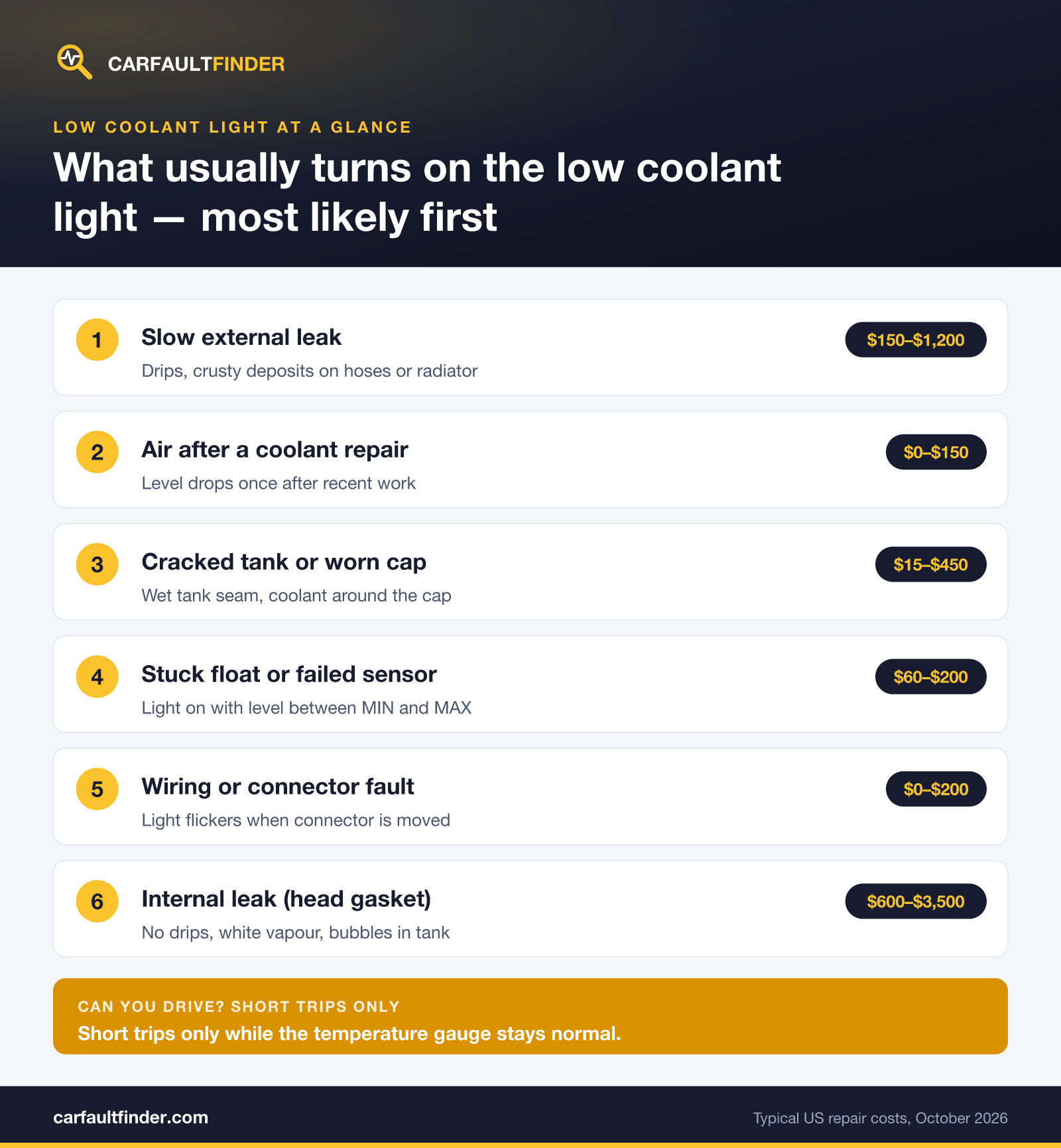
The low coolant light is caused by a genuinely low level far more often than by a bad sensor, so start with leaks. Causes run from most common to least. Typical US costs, October 2026 — varies by vehicle and region.
1. A slow external leak
Recognise it by: drips under the front of the car, crusty deposits on hoses, radiator seams or the water pump, and a sweet smell after driving. See coolant leaking under the car.
Usual fix: hose or clamp ($150–$400), radiator ($400–$1,200) or water pump ($350–$900).
2. Air working out after a repair
Recognise it by: recent cooling work and a level that drops once or twice, then stays put.
Usual fix: top up cold and bleed as the service manual describes ($0–$150).
3. A cracked expansion tank or worn cap
Recognise it by: a wet or crusty tank seam, or coolant around the cap after hard driving. See how to tell if your radiator cap needs replacing.
Usual fix: cap ($15–$60) or tank ($150–$450 fitted).
4. A stuck float or failed level sensor
Recognise it by: the light staying on with the cold level clearly between MIN and MAX; sludge or a cracked, coolant-filled float can hold it down.
Usual fix: sensor ($60–$200 fitted); on some cars it is built into the tank.
5. Wiring or connector faults
Recognise it by: a light that changes when you wiggle the connector or flickers over bumps.
Usual fix: clean, re-seat or repair ($0–$200).
6. An internal leak
Recognise it by: steady loss with a dry engine bay, white smoke from the exhaust once warm, bubbles in the tank or milky oil.
Usual fix: EGR or oil cooler ($600–$2,000) or head gasket ($1,500–$3,500).
Low Coolant Light vs Temperature Warning Light: What Is the Difference?
The low coolant light and the temperature warning light report different things. The low coolant light reads a float in the expansion tank; the temperature light reads a temperature sensor on the engine and warns of overheating. You can see one without the other.
| Low coolant light | Temperature light | |
|---|---|---|
| Colour | Usually amber | Red when hot, blue when cold |
| Measures | Level in the tank | Engine coolant temperature |
| Urgency | Check soon | Red: stop when safe |
When both appear together, the engine has already lost enough coolant to overheat; follow the temperature warning light guide.
What Should You Do When the Low Coolant Light Comes On?
When the low coolant light comes on, look at the temperature gauge first. If it is normal, finish the trip gently or pull over safely, switch off and let the engine cool before opening the bonnet (hood). If the gauge is climbing or you see steam, stop as soon as it is safe.
- Let it cool for at least 30 minutes.
- Read the level from outside the tank against MIN and MAX — see how to check coolant level safely.
- Top up cold with the coolant type in the owner’s manual, mixed 50/50 with distilled water.
- Note how much you added. A small top-up a year is normal; a litre (about a quart) a week is a leak.
Never open the expansion tank or radiator cap on a hot engine. Pressurised coolant can spray out above boiling point. Wait until the top hose is cool, then turn the cap slowly under a cloth.
Plain water will get you home in an emergency, but have the mix corrected afterwards. Wipe up spills: coolant tastes sweet and is poisonous to children and pets.
How Do You Narrow It Down?
Narrowing down a low coolant light takes a few simple checks, starting with the level and moving to leak hunting and a sensor test. Each step either confirms real coolant loss or clears the system and points at the sensor.
1. Mark the level (one week)
Top up cold to just below MAX, put tape at that height and recheck every few days. No change with the light on points to the sensor.
2. Look for external leaks (15 minutes)
Check hoses, clamps, radiator end tanks, the water pump weep hole, tank seams and the cap. Leave cardboard under the engine overnight.
3. Pressure test (shop, about 30 minutes)
A tester pumps the cold system to the cap rating, typically 13-18 psi (0.9-1.2 bar). A drop within 10-15 minutes with no visible drip suggests a hidden or internal leak.
4. Test the sensor (15 minutes)
Measure continuity across the sensor pins while moving the float, or hold a magnet near a removed sensor. It should switch cleanly between open and closed.
5. Rule out an internal leak (shop)
A chemical block test detects exhaust gas in the coolant; also check the oil for a milky colour.
How Much Does It Cost to Fix a Low Coolant Light?
Fixing a low coolant light costs $15-$60 for a top-up or new cap and $60-$200 for a level sensor; real leaks run from a $150 hose to a $3,500 head gasket. Typical US costs, October 2026 — varies by vehicle and region:
| Confirmed cause | Typical cost (parts + labour) |
|---|---|
| Top-up only / bleed after repair | $0–$150 |
| Pressure cap | $15–$60 |
| Level sensor or float | $60–$200 |
| Expansion tank | $150–$450 |
| Hose or clamp | $150–$400 |
| Radiator | $400–$1,200 |
| Water pump | $350–$900+ |
| Head gasket, EGR or oil cooler | $600–$3,500 |
What doesn’t work: bypassing the sensor (you lose your only early warning), stop-leak instead of a repair (it can clog heater cores), and replacing the sensor while the level keeps falling.
Can You Keep Driving With the Low Coolant Light On?
Driving with the low coolant light on is usually fine for a short distance if the temperature gauge stays normal and there is no steam. Top up once the engine is cool. Stop immediately if the gauge rises, the red temperature light appears or the heater blows cold: a few minutes of overheating can warp a cylinder head.
When Should You See a Mechanic?
See a mechanic when you top up more than once a month, cannot find where the coolant goes, or the light stays on with a full tank. Pressure testing and internal leaks need shop equipment. More guides are in our warning lights section.
Short trips are usually fine while the temperature gauge stays normal. Top up when cool, and stop at once if the gauge climbs or steam appears.
Book a mechanic if you add coolant more than once a month, the level falls with no drips, the light stays on with the tank full, or the engine has overheated. Never open the radiator or expansion tank cap on a hot engine — pressurised coolant can cause severe burns. Keep hands clear of the cooling fan, which can start on its own.
Frequently Asked Questions
Can a bad sensor cause a low coolant light?
Yes. A float stuck by sludge, a cracked float, a failed reed switch or a corroded connector can all switch the light on with the tank full. Confirm the level on a cold engine first: if it sits between MIN and MAX and the light stays on, test the sensor before hunting for leaks.
Why is my coolant low but there is no leak?
Coolant that disappears with no drips is usually leaking somewhere hot enough to evaporate it, such as a heater hose or water pump, or inside the engine through a head gasket, EGR cooler or oil cooler. A pressure test and a combustion gas test separate the two.
How long after topping up should the low coolant light go off?
On most cars the light goes out within seconds of starting once the level is above MIN; some recheck only at the next key cycle. If it stays on after a restart with the level correct, suspect the sensor, float or connector rather than the coolant.
Why does my low coolant light come and go?
A light that flickers on hills, in corners or on cold mornings usually means the level is sitting right at MIN. Coolant shrinks when cold and sloshes when the car moves, so the float crosses the switch point. Top up to between the marks; if it still flickers, check the connector.
Does a low coolant light mean a blown head gasket?
Rarely. Most low coolant lights come from external leaks, air after a repair or a faulty sensor. A head gasket becomes likely when coolant keeps disappearing with no drips, white vapour persists once warm, the tank bubbles or the oil turns milky. A block test confirms it.
How much coolant loss is normal?
Very little. A sealed system may drop slightly over a year, so a small top-up at a service is normal. Needing more than about half a litre (one pint) a month means a leak that should be found before it overheats the engine.