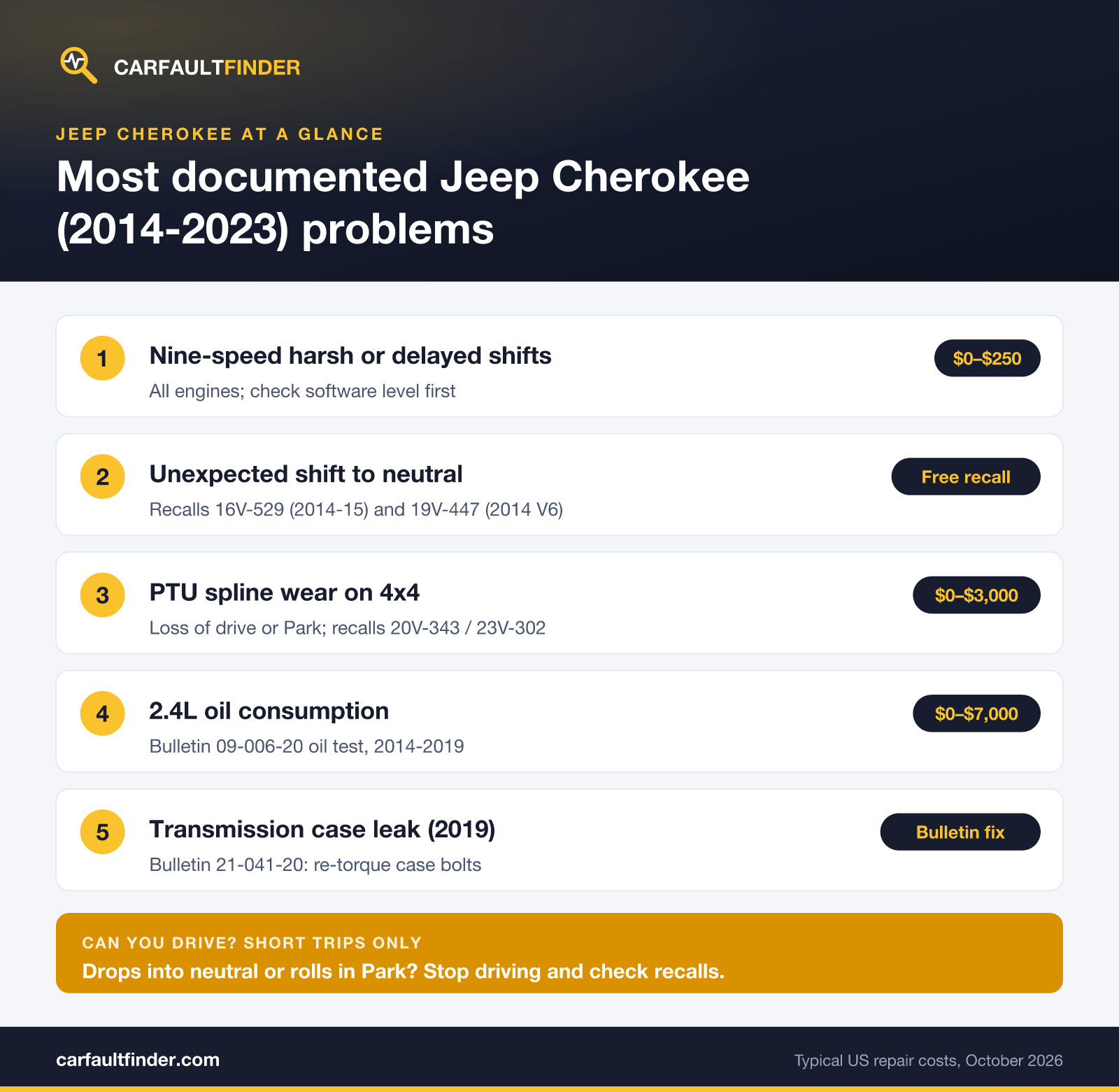
The most common Jeep Cherokee (2014-2023) problem is its nine-speed automatic: harsh or delayed shifts and, on some vehicles, an unexpected shift to neutral covered by recalls 16V-529 and 19V-447. 4×4 models with the two-speed PTU can lose drive or Park (recall 20V-343), and the 2.4L engine can burn oil.
- Recall 19V-447 covers 81,615 2014 Cherokees with the 3.2L V6; recall 16V-529 covers 2014-2015 nine-speed Cherokees with either engine.
- PTU recalls 20V-343 (67,248 vehicles) and 23V-302 (25,980) add software that engages the rear axle and parking brake if splines fail.
- FCA bulletin 09-006-20 sets a 1,500-1,700 mile oil consumption test for 2014-2019 Cherokees with the 2.4L engine.
- Check the VIN for open recalls and the transmission software level before paying for any transmission repair.
- Loss of drive or rolling in Park is a safety fault — stop driving until it is inspected.
- Which Jeep Cherokee Does This Guide Cover?
- What Is the Most Common Jeep Cherokee Problem?
- Why Can a Jeep Cherokee Shift Into Neutral by Itself?
- What Is the Jeep Cherokee PTU Problem?
- Does the Jeep Cherokee 2.4L Tigershark Engine Burn Oil?
- How Do You Check a Jeep Cherokee for These Problems?
- What Does It Cost to Fix Common Jeep Cherokee Problems?
- Which Jeep Cherokee Years Have the Most Problems?
- Can You Keep Driving a Cherokee That Drops Into Neutral?
- Frequently Asked Questions
- Related Guides
Which Jeep Cherokee Does This Guide Cover?
The Jeep Cherokee covered here is the KL generation sold in North America for 2014 to 2023: a compact unibody crossover with front-wheel drive or on-demand 4×4 and a nine-speed automatic on every version. The boxy XJ Cherokee of 1984-2001 is a different vehicle with different faults.
Engines were the 2.4-litre “Tigershark” four-cylinder, the 3.2-litre Pentastar V6 and, from the 2019 facelift, a 2.0-litre turbo. All three use the same nine-speed family, the 948TE — a Chrysler-built version of the ZF 9HP — so the transmission faults below are not limited to one engine.
| Model | Layout | Most documented issue |
|---|---|---|
| Cherokee (KL), 2014-2023 | Unibody, 9-speed auto | Nine-speed shift faults, neutral-shift recalls, PTU wear on 4×4 |
| Grand Cherokee | Larger SUV, 8-speed auto | Power-module (TIPM) electrical faults, air suspension — see our Jeep Grand Cherokee common problems guide |
| Wrangler | Body-on-frame, solid axle | “Death wobble” front-end shake |
What Is the Most Common Jeep Cherokee Problem?
The most common Jeep Cherokee problem is its nine-speed automatic: delayed or harsh shifts, hesitation pulling away, clunky downshifts while slowing and, on some vehicles, an unexpected shift into neutral. Complaints began with the 2014 launch, and the transmission received a long series of software updates afterwards.
- Hesitation from a stop — a pause before the vehicle pulls, then a firm engagement. See transmission shifts late or hesitates before engaging.
- Harsh low-gear shifts, especially 1-2 and 2-3 when cold, and a lurch when you accelerate mid-downshift — the pattern in transmission jerks when accelerating.
- A warning message and reduced power, with the gearbox holding one gear to protect itself — see car stuck in limp mode.
Much of this is control-software behaviour rather than broken hardware: the 948TE uses dog clutches that must line up before some gears engage, and its adaptive learning resets after a battery disconnect or update. Complaints that improve after a software update point to calibration; codes that keep returning, leaks or metal in the fluid point to hardware.
Why Can a Jeep Cherokee Shift Into Neutral by Itself?
A Jeep Cherokee can shift into neutral by itself because of two separate, documented defects, each covered by a recall with a free software remedy at a Jeep dealer. One applies to both engines; the other affects only 2014 models with the 3.2L V6.
| NHTSA recall | Cherokee covered | What goes wrong |
|---|---|---|
| 16V-529 (FCA S55), 2016 | 2014-2015 with the nine-speed (either engine); also 2015 Chrysler 200, Renegade, ProMaster | Insufficient crimps in the transmission sensor-cluster wiring can drop the gearbox into neutral |
| 19V-447 (FCA V69), 2019 | 2014 with the 3.2L V6 only (81,615 vehicles) | A stuck valve in the valve body stops a clutch releasing; the controller then commands neutral |
Both describe the same outcome: loss of drive while moving, without warning. FCA’s recall reports also say owners who paid for a repair of a recalled problem can seek reimbursement with proof of payment. “Only the V6 has transmission trouble” is not accurate.
What Is the Jeep Cherokee PTU Problem?
The Jeep Cherokee PTU problem affects 4×4 models with the two-speed power transfer unit: splines between the transmission output and the PTU differential can wear their teeth off. Once they do, torque no longer reaches the wheels — the car loses drive and Park can stop holding.
NHTSA recall 20V-343 (FCA W47, 2020) covers 67,248 Cherokees from 2014-2017 built between April 2014 and October 2016; 23V-302 (FCA 45A, 2023) adds 25,980 from 2016-2017. The remedy is software: if the splines fail, it lights the check engine lamp, engages the rear axle so the car can still move, and applies the electric parking brake in Park.
- Recognise it by: grinding or clicking near the front of the transmission, the engine revving with no movement, or the vehicle creeping in Park.
- Usual fix: recall software first; a worn PTU is replaced as a separate repair. Front-wheel-drive Cherokees have no PTU.
Does the Jeep Cherokee 2.4L Tigershark Engine Burn Oil?
The 2.4L Tigershark engine in the Jeep Cherokee can consume oil between changes, and FCA documented it: service bulletin 09-006-20 (revision B, July 2020) sets a dealer oil consumption test for 2014-2019 Cherokees with the 2.4L. The 3.2L V6 and 2.0L turbo are not listed in that bulletin.
External leaks are ruled out first. The oil is filled to FULL, the drain plug, filter, dipstick and cap are marked, and the owner drives 1,500 to 1,700 miles. At or above ADD, the engine is treated as acceptable; below ADD, the dealer asks FCA to approve a long-block (engine) replacement.
- Recognise it by: topping up between services with no drips under the car, or blue-grey smoke on start-up. Check with our how to check engine oil level properly guide.
- Usual fix: the documented test; keep receipts and mileage records. Running low on oil does far more damage than the consumption itself.
How Do You Check a Jeep Cherokee for These Problems?
Checking a Jeep Cherokee for its known problems starts with paperwork, not parts: a VIN recall check, a scan of the transmission module and the software level cost little or nothing. Match the symptom in the table first, then work through the steps in order.
| Symptom and condition | Most likely cause | Check first |
|---|---|---|
| Drops into neutral, revs with no drive | Recall 16V-529 / 19V-447 condition, or PTU failure (4×4) | VIN recall lookup; transmission codes |
| Hesitates from a stop, harsh 1-2 or 2-3 | Software calibration or adaptive learning | Transmission software level |
| Creeps or rolls in Park (4×4) | Worn PTU input splines | Recall 20V-343 / 23V-302 — stop driving |
| Needs oil between changes, no drips | 2.4L oil consumption | Dealer oil test (09-006-20) |
1. Run the VIN through a recall check
Enter the 17-character VIN at NHTSA’s recall lookup or ask a Jeep dealer for open campaigns before paying for diagnosis.
2. Read the transmission module, not just the engine
A basic engine-only reader may show nothing; transmission and PTU faults are stored in the transmission control module.
3. Ask for the software level and check fluids hot
A dealer can compare the installed calibration with the latest release. The 948TE has no dipstick: its level is checked hot through a fill plug with a special gauge, using ZF 8 & 9-speed fluid. Burnt-smelling fluid or metallic glitter is a hardware warning. On 2019 models, fluid under the left front may be the case leak in bulletin 21-041-20 (re-torqued case bolts).
What Does It Cost to Fix Common Jeep Cherokee Problems?
Fixing common Jeep Cherokee problems costs anything from nothing for open recall work to several thousand dollars for a replacement transmission or engine. These are typical US ranges, parts and labour together.
| Repair | Typical cost |
|---|---|
| Recall software (16V-529, 19V-447, 20V-343, 23V-302) | $0 at a Jeep dealer |
| Transmission software update outside a recall | $100 – $250 |
| Transmission fluid service (ZF-spec fluid) | $250 – $450 |
| PTU replacement (4×4) | $1,500 – $3,000 |
| Valve body replacement | $1,000 – $2,000 |
| Remanufactured transmission, installed | $4,000 – $6,500 |
| 2.4L engine (long block), if not under warranty | $4,000 – $7,000 |
Typical US costs, October 2026 — varies by vehicle and region.
What doesn’t work: replacing the transmission over a shift complaint before checking software and recalls, or adding generic “universal” fluid to a 948TE.
Which Jeep Cherokee Years Have the Most Problems?
The Jeep Cherokee years with the most documented problems are 2014 and 2015: they carry the wiring recall, the 2014 V6 neutral-shift recall, the PTU recall and most early shift complaints.
- 2014-2015: 16V-529; 19V-447 (2014 V6); 20V-343 (4×4); 2.4L oil bulletin.
- 2016-2017: 20V-343 and 23V-302 (4×4); 2.4L bulletin.
- 2018-2019: 2.4L bulletin; 2019 case-leak bulletin.
- 2020-2023: fewer documented patterns; still check the VIN.
Can You Keep Driving a Cherokee That Drops Into Neutral?
You should not keep driving a Jeep Cherokee that drops into neutral or loses drive, because it could happen next while pulling into traffic or on the motorway (highway). Harsh but consistent shifts are a nuisance; loss of drive or rolling in Park is a safety fault.
If it happens, switch on the hazard lights, steer to safety and stop. On 4×4 models, apply the electric parking brake in Park until the PTU recall is confirmed. For other makes, see our car brands section.
Harsh but consistent shifts can be driven to a dealer. If the Cherokee drops into neutral, loses drive or rolls in Park, stop driving and have it inspected — most fixes are free recall software.
Have a Jeep dealer or transmission specialist inspect the vehicle before further driving if the Cherokee has shifted into neutral, lost drive, rolled while in Park, or shows metal in the fluid. Open recalls are repaired free. Transmission, PTU and engine internals are not a driveway job: they need the vehicle safely raised on a lift, a scan tool for the transmission module and the correct fluids. Never work under a car supported only by a jack.
Frequently Asked Questions
Is the Jeep Cherokee transmission problem limited to the 3.2L V6?
No. Recall 19V-447 covers only 2014 Cherokees with the 3.2L V6, but recall 16V-529 covers 2014-2015 Cherokees with the nine-speed automatic regardless of engine, and shift-quality complaints and software updates apply to the 2.4L and later 2.0L turbo as well. All share the same 948TE nine-speed family.
How do I know if the recall work was done on my Cherokee?
Enter the 17-character VIN on NHTSA’s recall lookup or ask a Jeep dealer to check open campaigns. Completed recalls drop off the open list. A used Cherokee’s service records should also show the transmission software update and, on 4×4 models, the PTU software flash.
Will a software update fix my Cherokee’s harsh shifting?
Often it helps. Many Cherokee shift complaints are calibration rather than broken parts, and the transmission received a long series of software updates. After an update the gearbox needs some driving to relearn shifts. If harsh shifts return with codes, leaks or burnt fluid, a hardware fault is more likely.
What does PTU failure feel like on a Jeep Cherokee?
PTU failure on a 4×4 Cherokee usually shows as grinding or clicking near the front of the transmission, the engine revving with little or no movement, or the vehicle creeping in Park. Recalls 20V-343 and 23V-302 add software that engages the rear axle and parking brake if the splines fail.
How much oil consumption is normal for a 2.4L Cherokee?
FCA’s bulletin 09-006-20 uses a simple test: fill to FULL and drive 1,500 to 1,700 miles. If the oil is still at or above the ADD mark, the engine is treated as acceptable. Below ADD, the dealer can request approval for an engine replacement under warranty.
Is a used Jeep Cherokee a reliable buy?
A used Cherokee can be a reasonable buy if every open recall is complete, the transmission software is current, the PTU (on 4×4 models) has been serviced, and the 2.4L shows no heavy oil use. Avoid examples without records, especially 2014-2015 models, and have a test drive include cold starts.