A power steering warning light means the electric power steering (EPS) system has found a fault and may have reduced or cut steering assist. The car still steers, but it can feel much heavier at low speed. Check battery voltage first: below about 12 V running, many systems switch off assist.
- Running voltage should stay at 13.5–14.5 V; a sagging supply is one of the most common reasons the EPS light comes on.
- A light that appears right after a battery change usually needs a steering angle or torque sensor relearn, often $0–$150.
- The power steering and ABS lights together often mean the EPS has lost its vehicle speed signal.
- Column or rack replacement ($800–$3,000+) should come only after voltage, wiring and calibration are ruled out.
- What Does the Power Steering Warning Light Mean?
- When Did the Light Come On, and What Does That Point To?
- What Causes the Power Steering Warning Light?
- Can a Weak Battery Turn On the Power Steering Light?
- Why Did the Light Come On After a Battery Change?
- How Do You Narrow It Down?
- How Much Does It Cost to Fix?
- Can You Keep Driving With the Power Steering Light On?
- When Should You See a Mechanic?
- Frequently Asked Questions
- Related Guides
What Does the Power Steering Warning Light Mean?
The power steering warning light means the electric power steering (EPS) control module has found a fault and has reduced or switched off steering assist to protect itself or you. The car still steers mechanically, but it may feel much heavier below about 10 mph.
Most cars from the last 10-15 years use EPS: an electric motor on the column or rack, a torque sensor and a control module, with no fluid. Purely hydraulic systems rarely have a light; electro-hydraulic ones (an electric pump) can show one for a pump or fluid fault.
| What you see | Typical meaning |
|---|---|
| Steering wheel symbol with “!” in amber/yellow | Fault stored; assist may be reduced but is usually still working |
| Steering wheel symbol in red | Assist lost or a serious fault; expect heavy steering |
| “EPS” in letters | Electric power steering fault (common on Japanese and Korean cars) |
Colours, symbols and text messages vary by make; the owner’s manual is the final word.
When Did the Light Come On, and What Does That Point To?
The moment the power steering light came on is the fastest clue to its cause. A cold start points to voltage, recent battery work to calibration, and an ABS light alongside to a missing speed signal. Use this table before buying any parts.
| When it happens | Most likely cause | Check first |
|---|---|---|
| Cold morning start, slow cranking, light clears after a drive | Weak battery or poor terminal contact | Battery voltage and clamps |
| Right after a battery change, jump-start or disconnection | Steering angle/torque sensor lost its calibration | Relearn procedure for your model |
| Together with the ABS or traction control light | Missing vehicle speed signal (wheel speed sensor or ABS fault) | Scan the ABS module too |
| Comes and goes over bumps or in rain | Loose or corroded connector, ground or fuse | Connectors at the column or rack |
| Stays on every drive, steering heavy all the time | Failed torque sensor, motor or control module | Full scan with a chassis-capable tool |
What Causes the Power Steering Warning Light?
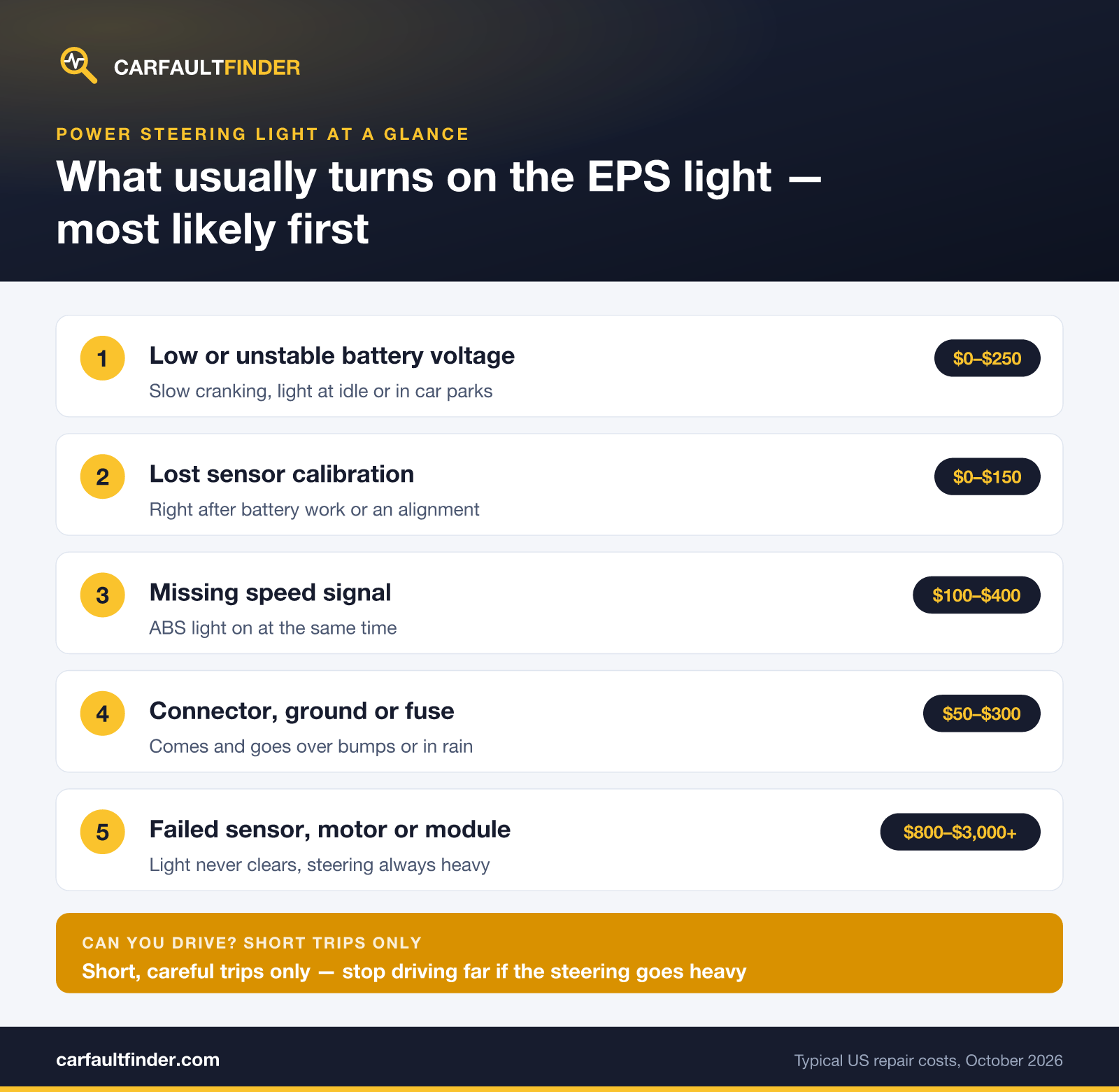
The power steering warning light has a short list of common causes, and the cheap ones lead. Supply voltage and lost calibration explain many lights that never needed a new rack or column, so rule them out before accepting a quote for expensive parts.
Low or unstable battery voltage. An EPS motor draws tens of amps when you turn at a standstill, so a tired battery, loose clamp or weak alternator lets voltage sag and the module cuts assist. Recognise it by: slow cranking and a light that appears in car parks and clears after a restart. Usual fix: clean the terminals or replace the battery, $0–$250.
Lost steering angle or torque sensor calibration. Many systems must relearn the straight-ahead position after battery disconnection, an alignment or steering work. Recognise it by: the light arriving right after that work. Usual fix: a relearn or scan-tool calibration, $0–$150.
Overheat protection. Repeated full-lock turns while stationary heat the motor, and the module reduces assist until it cools. Recognise it by: heavy steering only after lots of slow manoeuvring. Usual fix: none; drive normally for a few minutes.
A missing speed signal. EPS varies assist with road speed, usually read from the ABS module. Recognise it by: the power steering and ABS lights together. Usual fix: repair the wheel speed sensor or ABS fault, $100–$400.
Wiring, connector, fuse or ground faults. The EPS has its own high-current fuse, ground and data connection. Recognise it by: an intermittent light, or a network code such as U0131. Usual fix: repair the connector or ground, or replace the fuse after finding why it blew, $50–$300.
Failed torque sensor, motor or control module. On many cars the sensor and motor are only sold as part of the column or rack. Recognise it by: a light that never clears and steering that is always heavy. Usual fix: replace the column or rack, $800–$3,000.
Electro-hydraulic systems add low fluid or a worn pump; see the power steering fluid check.
Can a Weak Battery Turn On the Power Steering Light?
A weak battery can turn on the power steering warning light, and it is one of the most common reasons the light appears without any steering part failing. EPS is among the biggest electrical loads in the car, and the module cuts assist when supply voltage drops too low.
Measure across the battery posts with a multimeter; the battery voltage guide explains each reading.
| Condition | Healthy reading | Suspect if |
|---|---|---|
| Engine off, rested for an hour | 12.4–12.7 V | Below 12.2 V |
| Engine running, lights off | 13.5–14.5 V | Below 13.2 V or above 14.8 V |
| Running, turning the wheel lock to lock while stationary | Stays above about 12.5 V | Falls toward 12 V or lower |
Low running voltage may mean a charging fault; see how to tell a battery fault from an alternator fault. The light often clears a key cycle or two after the supply is fixed.
Why Did the Light Come On After a Battery Change?
A power steering light that appears right after a battery change, jump-start or disconnection is usually a calibration problem, not a new fault. Many EPS systems store the wheel’s centre position and the torque sensor’s zero point; losing power can wipe those values, and the module limits assist until they are restored.
On some cars, turning the wheel slowly lock to lock with the engine running, then driving briefly straight, is enough; others, including several Hyundai models per a service bulletin, need a scan-tool calibration. If the light returns afterwards, the supply problem is not fixed or another fault was hiding.
How Do You Narrow It Down?
Narrowing down a power steering warning light takes about 20-40 minutes with a multimeter and a scan tool that reads chassis (C) and network (U) codes. An engine-only reader often shows nothing.
1. Restart and note the conditions
Park safely, switch off for a minute and restart. If the light clears, note what was happening when it came on.
2. Check battery voltage and terminals
Measure resting and running voltage, and watch the meter while a helper turns the wheel at a standstill. Clean and tighten the clamps.
3. Scan every module
Read codes from the power steering, ABS and body modules. U0131 is the generic code for lost communication with the power steering control module; C1xxx steering codes mean different things on different makes, so look them up for your car. Other network codes, such as U0100, can point to a shared wiring or power problem.
4. Check fuses, grounds and connectors
Check the EPS fuse listed in the owner’s manual and look for corroded or loose connectors, unplugging nothing with the ignition on.
5. Run the relearn if needed
If battery work came first, calibrate. Only then suspect a sensor, motor or module.
How Much Does It Cost to Fix?
Fixing a power steering warning light costs nothing when it is overheat protection, and up to several thousand dollars when the column or rack must be replaced. Remanufactured columns and racks are often much cheaper than new dealer parts.
| Cause | Fix | Typical cost (parts + labour) |
|---|---|---|
| Loose or corroded battery clamp | Clean and tighten | $0–$30 |
| Weak battery | Replace battery | $150–$300 |
| Lost calibration | Relearn or scan-tool calibration | $0–$150 |
| Wheel speed sensor / ABS signal | Replace sensor or repair wiring | $100–$400 |
| Connector, ground or fuse | Repair wiring, replace fuse | $50–$300 |
| Column-mounted EPS motor/sensor | Replace column assembly | $800–$2,000 |
| Rack-mounted EPS | Replace rack, then align | $1,200–$3,000+ |
Typical US costs, October 2026 — varies by vehicle and region.
What doesn’t work
- Topping up fluid on a fully electric system: there is no fluid to add.
- Replacing the column or rack before checking voltage, grounds and calibration.
Can You Keep Driving With the Power Steering Light On?
You can usually drive with the power steering warning light on for a short, careful trip if the steering still feels normal, but not if it has gone heavy. Assist can disappear without warning, and the extra effort is greatest at low speed, in junctions and car parks.
If assist has dropped out, you need much more force at parking speeds, as the guide to a steering wheel that is hard to turn explains. Leave more room and head to a garage. Never switch the engine off while moving to “reset” the system; that also cuts brake assist.
When Should You See a Mechanic?
See a mechanic soon after the power steering warning light comes on and stays on, and straight away if the steering has gone heavy, the light is red, or it appears together with the brake or ABS warnings. EPS diagnosis needs tools most driveways do not have.
Check your VIN for recalls too: in 2014 Ford recalled about 179,000 2011-2013 Explorers (campaign 14V-286) because an intermittent connection in the steering gear could cut assist suddenly. Tell the garage when the light appears and which other lights were on; browse the warning lights guides for those.
Short, careful trips only. If the steering still feels normal, drive gently to a garage soon. If it has gone heavy or the light is red, avoid fast roads and allow extra room.
Steering is a safety system. Do not remove the steering column, rack or EPS motor yourself: these parts need calibration and exact torque settings after fitting. This is beyond a driveway job; your part is checking the battery, terminals and fuse.
Frequently Asked Questions
Is the power steering light the same as the steering lock warning?
No. The power steering light warns about the assist system: motor, sensors, module or supply voltage. A steering lock warning concerns the anti-theft column lock, and a lock fault usually stops the car starting at all.
Can I reset the power steering warning light myself?
Sometimes. If the cause was low voltage or overheating, the light often clears after a restart once the supply or temperature is back to normal. Lost calibration may clear after a lock-to-lock relearn, but many cars need a scan tool.
Why does my power steering light come on and then go off?
An intermittent light usually means a borderline supply or a loose connection. Voltage dipping during low-speed manoeuvres, a corroded clamp or a connector that loses contact over bumps can all trigger it. Measure battery and charging voltage, and note when it appears.
Does a power steering warning light drain the battery?
No, the lamp itself draws almost nothing. More often a weak battery causes the light. If the battery keeps going flat too, look for a charging fault or parasitic drain rather than the steering system.
Why are the power steering and ABS lights on together?
Electric power steering needs a vehicle speed signal, usually supplied by the ABS module. If a wheel speed sensor or the ABS module fails, the EPS loses that input and sets its own fault. Fixing the ABS problem first often clears both lights.
How long can I drive with the EPS light on?
Only as far as a garage, and sooner if the steering has gone heavy. Assist may drop out without warning, so avoid long trips and fast roads, and book a diagnosis within days, not weeks.