P0457 means your car’s evaporative emission (EVAP) system found a leak and blames the fuel cap: loose, missing or not sealing, usually right after refuelling. Tighten the cap until it clicks or fit a $15-$45 original-specification cap. The light normally goes out by itself after about three trips in which the leak test runs and passes.
- P0457 is the SAE J2012 code for Evaporative Emission System Leak Detected (Fuel Cap Loose/Off).
- A replacement cap typically costs $15-$45; a filler neck or capless filler repair runs $150-$600.
- Under generic OBD-II rules the light goes off after three consecutive trips in which the EVAP test passes, which can take several days.
- The EVAP test usually needs a cold start and a fuel level of roughly 15-85%, so a full tank delays it.
- What Does P0457 Mean?
- What Are the Symptoms of P0457?
- What Causes P0457?
- How Is P0457 Different From P0455, P0442 and P0456?
- How Do You Diagnose P0457?
- How Do You Fix P0457 and What Does It Cost?
- How Long Does P0457 Take to Clear After Tightening the Cap?
- Can a Capless Fuel Filler Set P0457?
- Can I Drive With P0457?
- When Should You See a Mechanic?
- Frequently Asked Questions
- Related Guides
What Does P0457 Mean?
P0457 is the generic OBD-II code for Evaporative Emission System Leak Detected (Fuel Cap Loose/Off). The engine computer ran its fuel vapour leak test, the system would not hold pressure or vacuum, and the result pointed to the fuel filler: a cap that is loose, missing or not sealing.
The EVAP system stores petrol vapour in a charcoal canister until the engine burns it. To test it, the computer closes a vent valve and watches whether a small pressure or vacuum holds.
What makes P0457 different is the timing. On many makes the logic notes that the fuel level has just risen, meaning you refuelled, and then sees a large leak on the next test. Because the filler was opened moments earlier, the computer blames the cap rather than reporting a general leak. The refuel logic varies by manufacturer, and some makes report a loose cap as P0455 instead.
What Are the Symptoms of P0457?
The symptoms of P0457 are usually mild: a steady check engine light that appears a day or two after filling up, often with a dashboard message about the cap. The engine runs exactly as before, because the fault is in the vapour circuit, not the fuel delivery.
- Check engine light, steady, frequently the first or second drive after refuelling.
- A cap or filler message, such as “Check Fuel Cap” or “Tighten Gas Cap” on some makes, or “Check Fuel Fill Inlet” on Ford capless cars.
- A faint fuel smell near the filler flap on a warm day. A strong smell inside the cabin is a separate problem; see car smells like gas inside the cabin.
- A failed emissions or OBD inspection while the light is on.
What Causes P0457?
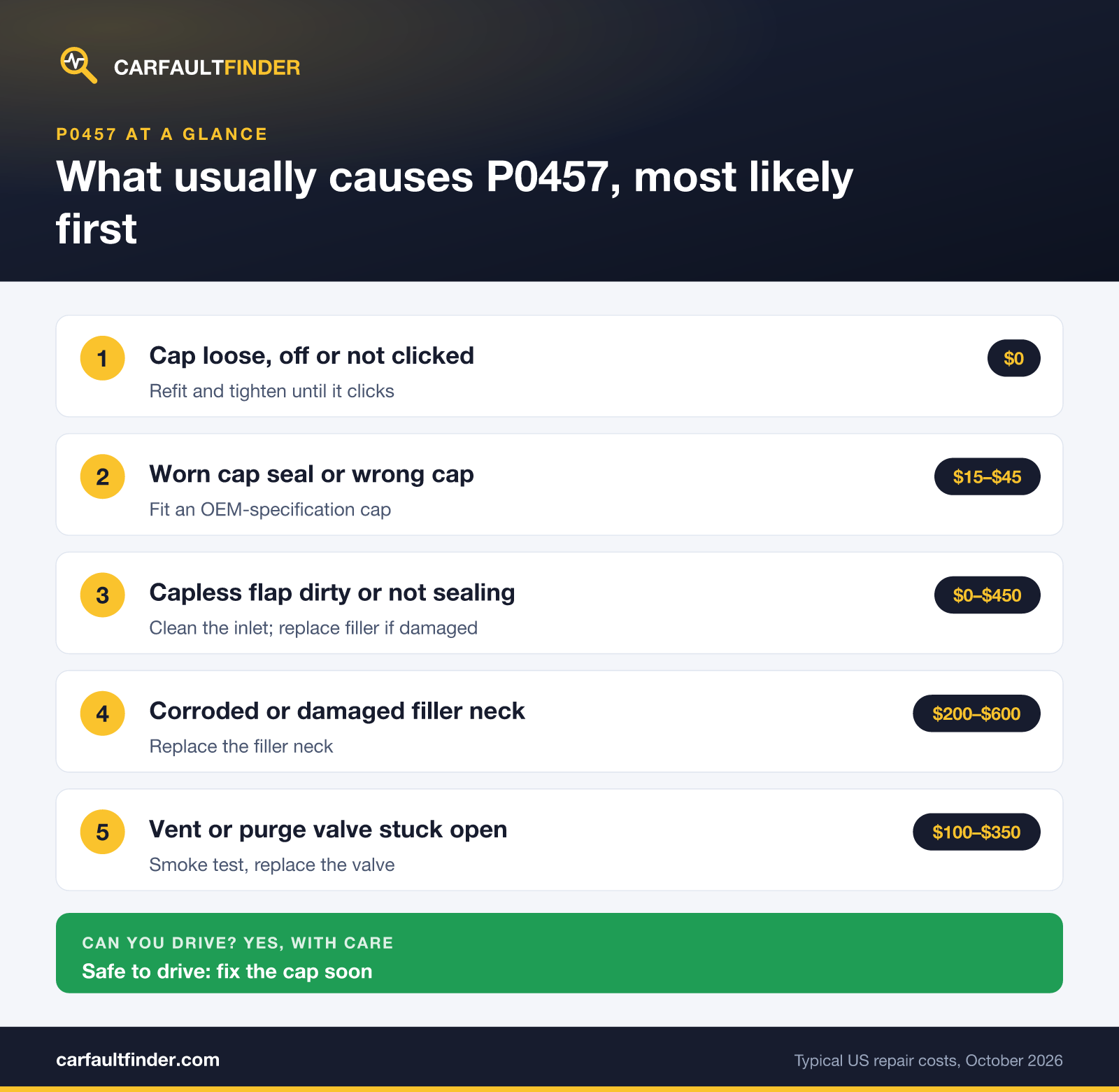
The causes of P0457 are concentrated at the filler end of the EVAP system, and most turn out to be the cap or the surface it seals against. In order of how often they are responsible:
- Cap not tightened until it clicks, left hanging on its tether, or forgotten at the pump.
- A worn or damaged cap seal. The rubber O-ring hardens, cracks or picks up grit, so a tight cap still leaks.
- The wrong cap. A cheap universal cap, or one from another model, may thread on but not seal or vent correctly.
- A damaged or corroded filler neck. Rust or a nick on the lip where the seal sits; common on older cars in salted-road regions.
- A capless filler flap not sealing because of dirt, a bent flap or a worn seal (Ford Easy Fuel and similar systems).
- A vent or purge valve stuck open. Either stops the system sealing, yet the computer still blames the cap.
- A split hose or cracked canister near the tank, less often.
How Is P0457 Different From P0455, P0442 and P0456?
P0457 differs from P0455, P0442 and P0456 in what the computer concludes, not just in leak size. The other three report how big a leak is; P0457 adds the context that the leak appeared straight after a refuel, so the filler is the prime suspect.
| Code | What the computer found | Where to look first |
|---|---|---|
| P0457 | Large leak detected soon after refuelling | Cap, cap seal, filler neck or capless flap |
| P0455 | Gross leak, no link to refuelling | Cap, then detached hoses, stuck vent valve |
| P0442 | Small leak (about 0.040 in / 1 mm) | Perished hoses and seals; smoke test |
| P0456 | Very small leak (about 0.020 in / 0.5 mm) | Cap seal, tiny cracks; smoke test |
| P0440 | General EVAP malfunction | Wiring, valves, pressure sensor |
If P0457 returns after a new cap, test the whole system as for P0455.
How Do You Diagnose P0457?
Diagnosing P0457 starts with the fuel cap and ends, only if the code keeps returning, with a professional smoke test. Most cases are settled in the first two steps, which need no tools and take about ten minutes, so there is no reason to buy parts before doing them.
1. Read the code and freeze frame (5 minutes)
Note every stored code. P0457 alone points at the filler; together with purge or vent codes such as P0441 or P0446, follow those first.
2. Inspect the cap and filler neck (5 minutes)
Remove the cap. Check the rubber seal for cracks, flattening or grit, and run a finger around the neck lip for rust, burrs or dents. Refit the cap until it clicks, and confirm it is the original-equipment part number for your car.
3. Pressure-test the cap (shop, 15 minutes)
Many shops have a cap adapter for the EVAP tester that shows whether the cap holds pressure on its own, separating cap from neck.
4. Smoke test the EVAP system (shop, 30-60 minutes)
Low-pressure smoke is fed into the system and escapes at the leak, including a stuck vent valve under the car. This is the step for a code that returns after a new cap.
Never use a flame or a compressed-air line to look for an EVAP leak, and do not pry open the capless flap with tools. Fuel vapour ignites easily.
How Do You Fix P0457 and What Does It Cost?
Fixing P0457 is usually the cheapest repair in the whole EVAP family, because the cap is the most common cause. Once the system can seal, the light goes out by itself after the test has passed. Typical US costs, October 2026 (varies by vehicle and region):
| Cause | Fix | Typical cost |
|---|---|---|
| Cap loose or left off | Refit and tighten until it clicks | $0 |
| Worn cap seal or wrong cap | OEM-specification cap | $15-$45 |
| Dirty capless flap | Clean the inlet, check the flap seats | $0-$100 |
| Damaged capless filler | Replace the filler assembly | $150-$450 |
| Corroded filler neck | Replace the filler neck | $200-$600 |
| Stuck vent or purge valve | Replace the valve | $100-$350 |
| Smoke test diagnosis | Locate the leak | $100-$200 |
What doesn’t work: clearing the code and hoping, which only resets the test; a universal cap that does not match the original; and replacing the charcoal canister without a smoke test showing it leaks.
How Long Does P0457 Take to Clear After Tightening the Cap?
P0457 normally clears on its own after the cap is fixed, but not on the next drive. The EVAP leak test only runs under specific conditions, so it can take several days of normal driving before the computer confirms the system is sealed.
Under generic OBD-II rules, the check engine light goes out after three consecutive trips in which the failed test runs and passes, and the code stays in history memory for about 40 warm-up cycles. The test itself has enable conditions that vary by maker; typical ones are:
- Fuel level roughly between 15% and 85% of the tank (GM service information uses this window).
- A genuine cold start after the car has sat for several hours, often overnight, with engine and air temperatures close together.
EPA guidance agrees: after tightening the cap, the light should go off within a few trips. Clearing it with a scan tool leaves the EVAP readiness monitor “not ready”; see how to reset a check engine light.
Can a Capless Fuel Filler Set P0457?
A capless fuel filler can still set P0457. Ford’s Easy Fuel system, for example, has no cap: a spring-loaded flap closes and latches when the nozzle is removed. If that flap or its seal does not close fully, the computer sees the same leak a loose cap would cause.
- Look into the inlet with a torch (flashlight) for grit, leaves or a flap that sits open.
- Use the supplied funnel for a fuel can. Ford supplies a funnel for this; a can spout pushed in can stop the flap seating.
If the inlet is clean and the code returns, the flap assembly or a valve is at fault.
Can I Drive With P0457?
You can drive with P0457. The engine, brakes and fuel delivery are unaffected, and the car will feel normal. The cost is environmental and practical: fuel vapour escapes, and an emissions inspection will fail while the light is on.
Do not leave it, though: while the light is already on, a second fault cannot turn on a new one (see check engine light on but car runs fine).
When Should You See a Mechanic?
See a mechanic for P0457 when a correctly fitted, original-specification cap does not stop the code, when the filler neck is visibly corroded, or when you smell fuel strongly. Beyond the cap, the work needs an EVAP smoke tester. More codes are in our trouble codes section.
Yes. P0457 does not affect how the car drives. Tighten or replace the cap soon so the car passes inspection and the check engine light can warn you of anything new.
See a mechanic if P0457 returns after you have fitted a correct, original-specification cap, if the filler neck is rusted or damaged, or if there is a strong fuel smell. Filler neck, capless filler and EVAP valve work is fuel-system work near the tank; it is beyond a driveway job, and a smoke tester finds the leak faster than guesswork.
Frequently Asked Questions
Will P0457 go away on its own?
P0457 usually goes away on its own once the cap is sealing again. The computer has to rerun its EVAP leak test and pass it on about three consecutive trips, and that test needs a cold start and a suitable fuel level. Expect several days of normal driving rather than one trip.
Is P0457 just a loose gas cap?
P0457 is most often a loose, missing or worn gas cap, which is why the code’s name mentions it. It is not always the cap, though. A corroded filler neck, a capless flap that does not close, or a stuck vent or purge valve can produce the same result after a refuel.
Can I clear P0457 with a scan tool?
You can clear P0457 with a scan tool, but it only resets the test. If the cap still leaks, the code returns once the EVAP test runs again. Clearing also sets the EVAP readiness monitor to not ready, which can get the car rejected at an inspection.
Will P0457 fail an emissions test?
P0457 will fail an OBD-based emissions inspection while the check engine light is on. Clearing the code just before the test does not help, because the EVAP monitor will show not ready. Fix the cause, then drive normally for several days first.
Why did P0457 appear after I filled up?
P0457 often appears after filling up because the cap was not clicked shut, the seal picked up grit, or the cap was left off. Many cars watch for a rise in fuel level, then run the leak test; a leak found at that point is blamed on the filler.
Can I use any replacement gas cap?
Use a cap that matches the original-equipment specification for your car. Caps differ in thread, seal and the pressure and vacuum relief valves built into them. A universal cap that fits loosely or vents wrongly can keep setting P0457 even when it is tight.