The best-documented Ford Escape problem is on 2013–2014 models with the 1.6L EcoBoost: driving with low coolant can overheat and crack the cylinder head, leaking oil that may catch fire (recalls 13V-583 and 17V-209). Later 1.5L models have coolant-intrusion and fuel-injector issues, and 2020–2023 hybrids an engine-failure recall. Check your VIN for free.
- Recall 17V-209 covered 2014 Escapes with the 1.6L EcoBoost after Ford logged 26 underhood fires linked to cracked cylinder heads.
- On 2013–2014 1.6L engines, starting and driving with coolant well below MIN is what triggers the head damage — check the degas bottle cold.
- 2017–2019 1.5L Escapes can draw coolant into the cylinders: watch for white smoke, misfires and a falling coolant level.
- Open recall repairs are free at a Ford dealer; a 17-character VIN lookup tells you what is outstanding.
- Which Ford Escape Years Have the Most Documented Problems?
- What Is the 1.6L EcoBoost Overheating and Fire Recall?
- What Is the 1.5L EcoBoost Coolant Intrusion Problem?
- Why Were 2020–2023 Escapes With the 1.5L Recalled for Fuel Injectors?
- What Is the Escape Hybrid and Plug-in Hybrid Engine Recall?
- Which Other Ford Escape Problems Are Worth Knowing?
- How Do You Check Whether Your Escape Is Affected?
- How Much Do Common Ford Escape Repairs Cost?
- Can You Keep Driving a Ford Escape With Low Coolant?
- Frequently Asked Questions
- Related Guides
Which Ford Escape Years Have the Most Documented Problems?
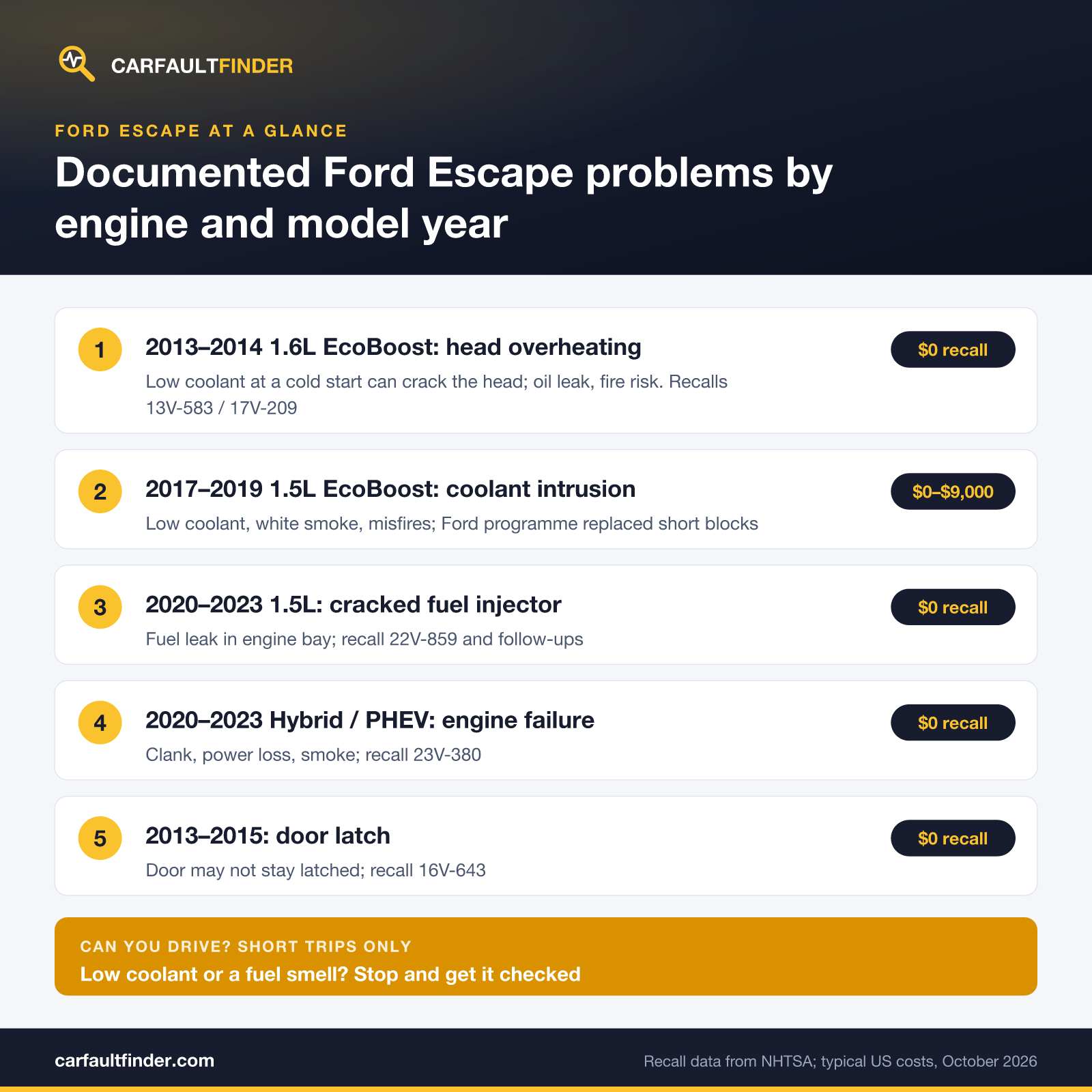
The Ford Escape problems with the strongest paper trail are tied to specific engines, not to the nameplate as a whole. The 2013 and 2014 Escape with the 1.6-litre EcoBoost were recalled because cylinder-head overheating could crack the head and leak oil onto hot parts; later 1.5-litre and hybrid models have their own documented recalls.
Find your model year and engine below. Recall eligibility always depends on your individual VIN, because Ford builds these vehicles out of VIN order.
| Model year and engine | Documented issue | Official action |
|---|---|---|
| 2013 Escape, 1.6L EcoBoost | Cylinder head overheats, cracks and leaks oil; underhood fire risk | NHTSA recall 13V-583 (Ford 13S12) |
| 2014 Escape, 1.6L EcoBoost | Same failure when the engine is started and driven with low coolant | NHTSA recall 17V-209 (Ford 17S09) — coolant level sensor added |
| 2013–2015 Escape (all engines) | Door latch component can break, so a door may not stay latched | NHTSA recall 16V-643 (Ford 16S30) |
| 2017–2019 Escape, 1.5L EcoBoost | Coolant seeping into the cylinders: low coolant, white smoke, misfires | Ford extended-coverage programme for the short block (not a safety recall) |
| 2020–2023 Escape, 1.5L EcoBoost | Fuel injector can crack and leak fuel in the engine bay | NHTSA recall 22V-859 (Ford 22S73) plus later follow-up recalls |
| 2020–2023 Escape Hybrid / Plug-in Hybrid, 2.5L | Rare engine failure can release oil and fuel vapour; fire risk | NHTSA recall 23V-380 (Ford 23S27), replacing 22V-484 |
Outside these rows, an Escape gets the ordinary wear any ageing SUV does. For other makes, see the car brands section.
What Is the 1.6L EcoBoost Overheating and Fire Recall?
The 1.6L EcoBoost overheating recall covers 2013 and 2014 Ford Escapes whose cylinder head can overheat locally, crack and release pressurised engine oil. If that oil reaches the turbocharger or exhaust, it can start an underhood fire. Ford handled the two model years in separate recalls, 13V-583 and 17V-209.
2013 Escape: recall 13V-583
Ford safety recall 13S12 covered 2013 Escapes with the 1.6-litre engine. The repair added enhancements to the engine shielding, cooling and control systems. A related recall, 13V-584, checked a fuel line fitted under an earlier 1.6L fuel-line recall (12S35).
2014 Escape: recall 17V-209
The 2017 recall explains the mechanism most clearly. According to Ford’s Part 573 report to NHTSA, the failure needs coolant well below the minimum mark in the coolant (degas) bottle at a cool or cold start. When the engine is then driven, the cylinder head heats rapidly and can crack. Ford reported 26 underhood fires with a cracked head as of March 2017 and no known crashes or injuries. The remedy installs a coolant level sensor, so the driver is warned before the engine runs dry. The recall also covered 1.6L Fusion, Fiesta ST and Transit Connect models.
On these engines low coolant is not a minor nuisance. Ford lists the warning signs as a visible leak, an overheat message, repeated top-ups or a low bottle — see coolant leaking under the car, a sweet coolant smell and a car that overheats while driving. Smoke or a hot-oil smell from the engine bay means stop: out of coverage, a cracked head typically costs $2,000–$4,000.
What Is the 1.5L EcoBoost Coolant Intrusion Problem?
The 1.5L EcoBoost coolant intrusion problem affects some 2017–2019 Ford Escapes, where coolant seeps into one or more cylinder bores. Ford describes the symptoms as a low coolant level, white exhaust smoke and a rough-running engine, with or without the check engine light. It is a separate issue from the 1.6L cylinder-head recall.
Ford handled this through a customer satisfaction programme, not a safety recall: dealers confirm coolant in the cylinders, often with a borescope, then replace the short block. Coverage ran 7 years or 84,000 miles from warranty start; ask a dealer whether anything still applies to your VIN.
The codes Ford lists include random and single-cylinder misfires (P0300 and P0301–P0304), P0316 (misfire detected on start-up), P0217 (engine overtemperature), and P1285 and P1299 — two Ford-specific codes for cylinder-head overtemperature and the engine’s heat-protection mode. Other makes use P1285 and P1299 for different faults, so read them with a scan tool that shows Ford manufacturer codes.
Sweet-smelling white smoke at a cold start is the giveaway — see white smoke from the exhaust. Out of coverage, a short block typically costs $5,000–$9,000.
Why Were 2020–2023 Escapes With the 1.5L Recalled for Fuel Injectors?
The 2020–2023 Ford Escape with the 1.5L EcoBoost was recalled because a fuel injector can crack and leak fuel inside the engine compartment, where hot engine or exhaust parts could ignite it. NHTSA campaign 22V-859 (Ford 22S73) covered about 521,778 Escape and Bronco Sport vehicles and replaced an earlier recall, 22V-191.
The remedy added injector-leak detection software and a drain tube. Ford has since issued further recalls on the same injectors, including a 2025 campaign (Ford 25S76), so a car that was “already done” may need another visit.
A petrol (gasoline) smell is the warning sign; do not trace a fuel leak yourself — see our guide to a car that smells like gas inside the cabin explains what to do safely.
What Is the Escape Hybrid and Plug-in Hybrid Engine Recall?
The Escape Hybrid and Plug-in Hybrid recall covers 2020–2023 models with the 2.5-litre petrol engine. Ford reported that isolated manufacturing issues can make the engine fail early; if it does, oil and fuel vapour can be released into the engine bay and gather near hot parts, raising the risk of fire. The current campaign is 23V-380.
Recall 23V-380 (Ford 23S27) replaced the 2022 recall 22V-484 and covers about 125,322 Escape, Maverick and Lincoln Corsair vehicles; cars fixed under the first recall need the newer remedy. Ford advises parking and switching off if you hear a metallic clank, lose power or see smoke.
These are high-voltage vehicles: do not touch the orange cables or battery pack, and leave hybrid-system work to a trained technician.
Which Other Ford Escape Problems Are Worth Knowing?
Beyond the engine recalls, the most widely documented Ford Escape defect is a door latch that can break on 2013–2015 models. Recall 16V-643 (Ford 16S30) replaces the latch, because a door that does not latch properly could open while driving. It covered several Ford models, the Escape among them.
- Automatic gearbox complaints: harsh or delayed shifts are reported on some years — complaints, not a recall; start with transmission slipping symptoms.
Keep the Escape separate from its siblings: the Ford Focus is best known for its PowerShift dual-clutch gearbox, the Ford Explorer for exhaust smell in the cabin, and the Ford F-150 for an EcoBoost stumble in humid weather.
How Do You Check Whether Your Escape Is Affected?
Checking whether a Ford Escape is affected takes three steps: look up the VIN for open recalls, check the coolant level cold, and scan for codes if anything looks wrong. The free VIN check is the only reliable answer, because these recalls depend on build dates.
- Run the VIN. Enter the 17-character VIN at NHTSA’s recall lookup or Ford’s owner site; ask a dealer about satisfaction programmes, which may not appear.
- Check the coolant cold. With the engine fully cold, the level in the degas bottle should sit between MIN and MAX. Never open a hot cooling system — follow our guide to checking coolant level safely.
- Note how often you top up. Topping up every few weeks means a leak, inside or outside the engine.
- Scan for codes. A basic OBD-II reader (about $20–$60) shows P0300–P0304 and P0217; Ford-specific codes such as P1285 and P1299 need a reader that supports Ford enhanced codes.
How Much Do Common Ford Escape Repairs Cost?
Ford Escape repair costs range from nothing at all for open recall work to several thousand dollars for an engine failure outside warranty or programme coverage. These are typical ranges, not quotes.
| Repair | When it applies | Typical cost |
|---|---|---|
| Open safety recall work | Any open recall on your VIN | $0 at a Ford dealer |
| Cooling-system pressure test | Coolant keeps dropping, no visible leak | $100–$200 |
| Hose, coolant bottle or water pump | External leak found | $150–$900 |
| Cylinder head replacement (1.6L) | Cracked head, not covered | $2,000–$4,000 |
| Short block / engine replacement (1.5L) | Coolant intrusion, not covered | $5,000–$9,000 |
| Door latch replacement | Latch fault outside recall | $250–$500 per door |
Paid for a repair before a recall notice arrived? Keep the invoice and ask the dealer about Ford’s reimbursement plan.
Can You Keep Driving a Ford Escape With Low Coolant?
A Ford Escape with low coolant should not be driven until the cause is found, particularly a 2013–2019 EcoBoost model. Ford’s own recall report says that starting a cold engine with coolant well below the minimum mark and driving off is exactly how the 1.6L cylinder head overheats and cracks.
Slightly under MIN with no warnings? Top up with the correct coolant (see coolant types explained) and drive gently to a garage. Empty bottle, temperature warning or smoke? Arrange recovery — a tow costs far less than an engine.
Drive only with coolant between MIN and MAX, no warnings and no fuel or hot-oil smell; otherwise stop and arrange recovery.
See a Ford dealer or qualified mechanic straight away if you smell fuel, see smoke or smell hot oil from the engine bay, get an overheat warning, or find the coolant bottle empty. Never open a hot cooling system — pressurised coolant scalds. Tracing fuel leaks and hybrid high-voltage work are beyond a driveway job. Open recall repairs are free.
Frequently Asked Questions
What is the most common problem with the Ford Escape?
On 2013–2014 models with the 1.6L EcoBoost, it is cylinder-head overheating that can crack the head and leak oil, creating a fire risk. Recalls 13V-583 and 17V-209 addressed it; later 1.5L and hybrid Escapes have separate recalls.
Which Ford Escape years should I avoid?
The most documented trouble sits with the 2013–2014 1.6L and 2017–2019 1.5L EcoBoost. Not every car is bad: one with completed recall work, a stable coolant level and service records can be a sound buy. Run the VIN before purchase.
How do I know if my Escape’s recall was done?
Enter the VIN at NHTSA’s recall lookup or Ford’s owner website; a completed recall no longer shows as open. A Ford dealer can also check satisfaction programmes that may not appear in public searches.
Why does my Ford Escape keep losing coolant with no leak?
It may be burning inside the engine, as with the 1.5L coolant-intrusion issue, or leaking somewhere hot where it evaporates. A pressure test (about $100–$200) plus a check for white exhaust smoke usually narrows it down.
Is the Ford Escape 1.5 EcoBoost reliable?
Many run without trouble, but 2017–2019 Escapes have a documented coolant-intrusion pattern and 2020–2023 models a fuel-injector recall. Watch the coolant level, complete recall updates and investigate misfires or white smoke early.
Is it expensive to fix a cracked cylinder head on an Escape?
Yes. Outside recall or warranty coverage, a 1.6L EcoBoost cylinder head replacement typically costs $2,000–$4,000 (October 2026 estimate), which is why a correct coolant level and the recall’s coolant sensor matter so much.