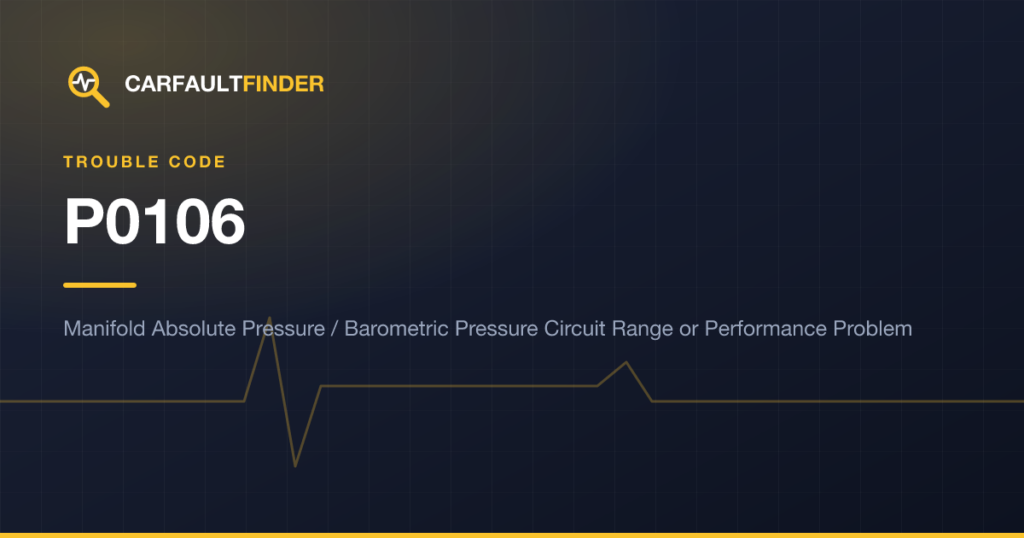
P0106 means the manifold absolute pressure (MAP) reading is electrically plausible but doesn’t agree with what the engine computer expects given throttle position, RPM and airflow — a “range or performance” fault rather than a circuit failure. That distinction matters: because this code is set by a disagreement rather than a dead circuit, a vacuum leak, a blocked sensor port or a clogged air filter can trigger it just as easily as a failed sensor, and replacing the sensor first is often wasted money.
What Does P0106 Mean?
The MAP sensor measures absolute pressure inside the intake manifold. At idle with the throttle closed, the engine pulls a strong vacuum and manifold pressure drops well below atmospheric; at wide-open throttle it rises close to atmospheric (or above it, on a turbocharged engine). The ECU uses that reading to work out how much air is entering each cylinder, and therefore how much fuel to inject. Many vehicles also read barometric pressure from the same sensor at key-on to know their altitude.
P0106 is a plausibility check, not a circuit test. The signal is within its normal voltage range — that’s what separates it from the “high input” and “low input” codes — but its value conflicts with throttle position, engine speed and, where fitted, the mass airflow sensor. The ECU is effectively saying: this number is possible, but not possible right now.
Codes ending in 6 are typically rationality checks — the ECU comparing several inputs against each other. A perfectly healthy MAP sensor will report a manifold pressure that’s genuinely higher than it should be at idle if a vacuum leak is letting extra air in. The sensor is telling the truth; the engine is the thing that’s wrong. This is the same trap our P0325 guide describes for knock sensors.
Common Symptoms
- Check engine light on.
- Rough or unstable idle, since fuelling is calculated from a reading the ECU doesn’t trust.
- Hesitation or surging under acceleration — see our car loses power when accelerating guide.
- Poor fuel economy, and in richer cases black smoke from the exhaust.
- Hard starting, particularly when warm.
- Noticeably worse behaviour after a big altitude change on vehicles that take barometric pressure from this sensor.
Common Causes, Most Likely First
- A vacuum leak — cracked hoses, a leaking intake manifold gasket, a split intake boot, or a stuck PCV valve. This raises manifold pressure above what the ECU expects at idle and is the most common trigger. If P0171 or P0174 is stored alongside, treat a leak as the leading theory.
- A blocked or oil-fouled MAP sensor port, where the small passage connecting the sensor to the manifold has clogged with carbon or oil mist, damping and delaying the reading.
- A disconnected, cracked or collapsed vacuum hose to the sensor, on designs where the MAP sensor is mounted remotely rather than screwed directly into the manifold.
- A restricted air intake — a badly clogged air filter changes the pressure relationship the ECU is checking against, and is worth ruling out because it costs almost nothing.
- A failed MAP sensor, which does happen but sits below the cheaper causes for this particular code.
- Damaged wiring or a corroded connector giving a sluggish or intermittent signal.
- Mechanical engine problems — worn rings, a leaking head gasket, or significant valve timing error — which genuinely change manifold vacuum. Least likely, but the reason a low or unsteady vacuum reading shouldn’t be dismissed.
How to Diagnose It
- Compare live MAP data against reality. Key on, engine off, the sensor should read close to barometric pressure — roughly 29–30 inHg or about 101 kPa at sea level. At a warm idle it should drop to roughly 17–21 inHg of vacuum (about 30–40 kPa absolute) and stay steady. A reading that doesn’t move much between those two states, or that wanders at a steady idle, is the fault in plain sight.
- Watch the reading through a throttle snap. It should rise sharply toward atmospheric and fall back quickly. A lazy, damped response points at a blocked port or hose rather than a dead sensor.
- Check fuel trims. Strongly positive trims at idle that shrink at higher RPM are the signature of a vacuum leak, and redirect the whole diagnosis away from the sensor.
- Inspect the sensor port and hose, removing the sensor to look for carbon or oil in the passage. Cleaning it costs nothing and fixes a fair share of cases.
- Check the air filter — genuinely, before buying anything.
- Inspect wiring and the connector for damage and corrosion, and check the sensor’s reference voltage and ground.
- Consider a smoke test if fuel trims say leak but you can’t find it by hand.
Never work under a vehicle supported only by a jack. Use axle stands on firm, level ground, chock the wheels that stay down, and leave the car in gear or Park with the handbrake on. A jack lifts; stands hold.
Possible Fixes
| Cause | Fix | Typical cost |
|---|---|---|
| Clogged air filter | Replace the filter | $15 – $60 |
| Cracked vacuum hose | Replace the hose | $10 – $40 |
| Blocked MAP sensor port | Clean the port and passage | $0 – $60 |
| Damaged wiring/connector | Repair the affected section | $50 – $180 |
| Failed MAP sensor | Replace the sensor | $80 – $250 |
| Leaking intake manifold gasket | Replace the gasket | $200 – $500 |
What usually doesn’t work: fitting a new MAP sensor as step one. A range/performance code is the ECU reporting a disagreement between inputs, and the disagreement is more often caused by air the sensor can see but the ECU didn’t account for. Confirm with live data and fuel trims before spending — the same principle covered in what an OBD-II scanner can and can’t tell you.
Can I Drive With P0106?
Yes, with care, and preferably not for long. The car is running on a fuel calculation the computer knows is suspect, which typically means worse economy, a rough idle and hesitation rather than anything dangerous. Two things move it up the list: a persistently rich mixture can foul plugs and, over time, load the catalytic converter, and if the underlying cause is a vacuum leak then the engine is also running lean under some conditions. If a misfire code such as P0304 appears alongside, deal with it sooner.
When to See a Mechanic
Within a week or two for a steady light, sooner if the idle is rough enough to stall or the car hesitates badly under load. Ask for live MAP data and fuel trims to be checked before any part is fitted. More in our trouble codes section and our engine problems section.
Frequently Asked Questions
What does the P0106 code mean?
The manifold absolute pressure reading is within its normal electrical range but doesn’t agree with what the engine computer expects given throttle position, engine speed and airflow. It’s a plausibility fault rather than a circuit failure.
Can a vacuum leak cause P0106?
Yes, and it’s the most common cause. Extra unmetered air raises manifold pressure above what the ECU expects at idle, so a perfectly healthy sensor reports a value that conflicts with the other inputs.
How do I test a MAP sensor?
Compare live data against known values: key on with the engine off it should read close to barometric pressure, and at a warm idle it should drop to roughly 17–21 inHg of vacuum and hold steady. A reading that barely changes between those states, or responds sluggishly to a throttle snap, is faulty or has a blocked port.
Is it safe to drive with a P0106 code?
Generally yes in the short term. Expect worse fuel economy, a rougher idle and some hesitation. Have it looked at within a week or two, and sooner if the car stalls or hesitates badly under load.
How much does it cost to fix P0106?
Often very little — an air filter, a cracked vacuum hose, or simply cleaning a blocked sensor port. A replacement MAP sensor runs $80 to $250, and an intake manifold gasket is the expensive end at $200 to $500.